


Does Anyone Know a Good Dyscalculia Tutor Online in 2026?

Updated: Aug 12

Last Updated August 1, 2026
"It's hard trying to find someone who even knows what I'm talking about when I mention dyscalculia."
You're not imagining it.
The blank stares when you bring it up at parent-teacher conferences. The well-meaning teachers who suggest "more practice" or "flash cards." The tutors who confidently say they can help—until you explain what dyscalculia actually is, and suddenly they're "not sure they're the right fit."
Here's the uncomfortable truth: there are far too many people—including professionals—who don't even know about this learning difference.
Dyscalculia affects 5-7% of the population. That's roughly the same prevalence as dyslexia. Yet it remains education's "forgotten learning disability"—underfunded, under-researched, and largely invisible in teacher training programs.
Now imagine this: If it's already hard to find someone who's even heard of dyscalculia, can you imagine how hard it is to find a tutor who not only knows about it but can effectively tutor a child with dyscalculia?
You're not being picky. You're not being difficult. You're being a good parent.
Because here's what you already know in your gut: Your child doesn't need "more of the same." They don't need another tutor who'll reteach long division the exact same way it didn't work the first five times.
They need someone who understands how their brain processes numbers differently—and knows exactly how to bridge that gap.
The good news? Qualified dyscalculia specialists do exist.
The challenge? Knowing what credentials actually matter, what questions to ask, where to look, and what red flags to avoid.
This guide will walk you through everything you need to find a truly qualified online dyscalculia tutor—one who can transform your child's relationship with math from frustration and tears to confidence and genuine understanding.
Your child deserves someone who gets it. Let's find them.
📥 Not sure if your child has dyscalculia?
Take our free comprehensive guide. It's backed by research and created by an actual educator. And did I mention, it's free!?!?!
Quick Answer: Can Online Dyscalculia Tutoring Actually Be Effective?
Yes. Dyscalculia intervention can be highly effective online when the instruction is individualized, interactive, and provided by someone who understands how students with dyscalculia learn mathematics. The effectiveness of intervention depends much more on the quality and specialization of the instruction than on whether the tutor and student are sitting in the same room.
Effective online dyscalculia intervention should still include explicit instruction, visual and multisensory representations, active student participation, immediate feedback, and opportunities for the instructor to observe how the student approaches mathematical problems. Online instruction should not mean simply watching someone explain math on a screen.
At MindBridge Math Mastery, sessions are live, one-on-one, and designed specifically for the individual student. I use interactive digital tools, visual models, multisensory strategies, and diagnostic teaching throughout sessions so I can see not only whether a student gets an answer correct, but how they are thinking through the mathematics.
Why Finding a Dyscalculia Tutor Feels Impossible
Here's why your search has been so frustrating—and why it's not your fault.
Most teachers get zero training in dyscalculia. Not "a little." Not "one elective course." Nothing. Compare that to dyslexia, which now has screening protocols, intervention programs, and state-mandated teacher training. Dyscalculia? It barely gets a mention in most education programs.
"Just practice more" doesn't work—and often makes things worse. Dyscalculia isn't a "math skills" problem. It's a number sense processing difference. Asking a child with dyscalculia to do more worksheets is like asking someone with dyslexia to "just read harder." More repetition without addressing the underlying processing difference = more failure, more anxiety, deeper avoidance.
You need a specialist, not a generalist. When you search for help, you're not looking for someone to explain tonight's homework. You need someone with specialized training in dyscalculia intervention—someone who knows how to rebuild foundational number sense using multisensory, research-based methods. That's a very specific skillset, and most tutors don't have it.
The good news? Online tutoring means you're not limited by geography. A certified dyscalculia specialist in California can work with your child in Texas. You just need to know what credentials actually matter.
💡 The Bottom Line
"The difference between a general tutor and a dyscalculia specialist? One reteaches what didn't work. The other rebuilds the foundation using methods designed for how your child's brain actually works."
What Makes a Tutor Truly Qualified (The Complete Evaluation Framework)
Not all tutors are created equal. And when it comes to dyscalculia, the difference between a generalist and a specialist isn't just preference—it's the difference between wasting time and actually making progress.
Here's exactly what to look for, what questions to ask, and what red flags should send you running.
The Credentials That Actually Matter
"I'm a certified teacher" or "I have a math degree" isn't enough. Your child needs someone with specialized training in how dyscalculia works and evidence-based interventions that address it.
Here's what qualifies someone:
✅ Specialized Dyscalculia Training
Look for completion of recognized dyscalculia intervention programs:
Dr. Schreuder's Dyscalculia Certification (Netherlands-based, internationally recognized)
Ronit Bird's Dyscalculia Training (UK-based specialist)
Steve Chinn's Dyscalculia Programs (math learning difficulties expert)
Mahesh Sharma's Mathematics as a Second Language (dyscalculia and math anxiety specialist)
Why it matters: These programs teach tutors how to identify specific dyscalculia markers, assess number sense deficits, and implement research-based interventions—not just "try harder" strategies.
What to ask: "What specific dyscalculia training have you completed, and when?"
✅ Multisensory Math Instruction Certification
Dyscalculia intervention requires multisensory approaches. Look for:
Marilyn Zecher's Multisensory Math Certification (Levels 1 & 2)
Math-U-See training (concrete-representational-abstract approach)
TouchMath certification (multisensory number sense)
CRA (Concrete-Representational-Abstract) methodology training
Why it matters: Kids with dyscalculia can't learn through traditional visual/auditory-only instruction. They need to see it, hear it, touch it, and move with it. Certified multisensory instructors know how to integrate manipulatives, visual models, and kinesthetic activities systematically.
What to ask: "How do you incorporate multisensory techniques into your lessons? Can you give me an example of how you'd teach place value using concrete manipulatives?"
✅ Educational Therapy Background
Educational therapists address learning differences holistically—not just academically, but emotionally and cognitively.
Look for:
NILD (National Institute for Learning Development) training or certification
AET (Association of Educational Therapists) membership or certification
Why it matters: Dyscalculia rarely exists in isolation. Many kids also struggle with executive function, working memory, processing speed, or anxiety. Educational therapists are trained to address the whole learner, not just the math gaps.
What to ask: "Do you have educational therapy training? How do you address executive function and confidence alongside math skills?"
✅ Advanced Degrees (With Caveats)
A Master's degree in Math Education, Special Education, or Educational Psychology is helpful—but not sufficient on its own.
Why it matters (and why it's not enough): Advanced degrees provide deep content knowledge and understanding of learning theory. But unless the program included specialized coursework in dyscalculia or math learning disabilities, the tutor still needs additional training.
What to ask: "What coursework or training in learning disabilities—specifically dyscalculia—did your degree program include?"
✅ Proven Experience with Dyscalculia Students
Credentials are important, but experience working specifically with dyscalculia is equally critical.
Look for:
Years working with dyscalculia students (not just "struggling math students")
Ability to conduct or interpret dyscalculia screenings/assessments
Understanding of co-occurring conditions (ADHD, dyslexia, anxiety)
Portfolio of student outcomes with measurable progress (not just generic testimonials)
What to ask:
"How many students with dyscalculia have you worked with?"
"Can you describe a recent student's progress—specific skills improved and timeline?"
"What do you do when a student has both dyscalculia and ADHD?"
Red Flags vs. Green Flags
🚩 Red Flags | ✅ Green Flags |
|---|---|
"I can tutor any subject" | "I specialize in math learning differences" |
Focuses only on homework completion or test prep | Focuses on building number sense and conceptual understanding |
Uses only worksheets and repetition | Uses manipulatives, visual models, and kinesthetic activities |
Can't explain their dyscalculia approach in detail | Articulates specific multisensory methodology (CRA, explicit instruction) |
Promises quick fixes ("We'll catch them up in 6 weeks!") | Sets realistic timelines (months to years for comprehensive intervention) |
No mention of assessment or progress tracking | Conducts initial screening and ongoing progress monitoring |
Generic credentials ("certified teacher," "math degree") | Specific dyscalculia/multisensory training certificates listed |
Talks about "fixing" or "overcoming" dyscalculia | Uses neurodiversity-affirming language ("supporting," "working with their strengths") |
Generic testimonials ("Great tutor! Very patient!") | Specific outcomes ("Went from F to B in 4 months; now volunteers to answer questions in class") |
Charges significantly less than market rate for specialized tutoring | Pricing reflects specialized training and individualized planning ($75-$200+/hour) |
Vague about methodology ("I use different strategies") | Clear about approach ("I use CRA progression with multisensory techniques based on Marilyn Zecher's framework") |
Your Vetting Checklist (Questions to Ask Before Hiring)
Don't just take a tutor's word for it. Use these questions in your consultation calls to separate true specialists from well-meaning generalists.
📋 About Training & Experience
1. "What specific training do you have in dyscalculia intervention?"
What you're listening for:
Specific program names (Dr. Schreuder, Ronit Bird, Steve Chinn, Mahesh Sharma)
Completion dates (recent training shows ongoing professional development)
Certificates or credentials they can provide
Red flag answer: "I've worked with lots of struggling math students" or "I've read about it"
Green flag answer: "I completed Dr. Schreuder's Dyscalculia Certification in 2023 and Marilyn Zecher's Multisensory Math Level 1 and 2 in 2021. I also have NILD educational therapy training."
2. "How many students with dyscalculia have you worked with, and for how long?"
What you're listening for:
Specific numbers (not "many" or "several")
Duration of work with each student (long-term relationships show effectiveness)
Range of ages and severity levels
Red flag answer: "I've tutored lots of kids who struggle with math"
Green flag answer: "I've worked with 15-20 students with diagnosed or suspected dyscalculia over the past 5 years. Most stay with me for 1-3 years. I work with students from 2nd grade through high school."
3. "Can you describe your approach to teaching [place value/fractions/specific struggle area] to a student with dyscalculia?"
(Insert whatever concept your child specifically struggles with)
What you're listening for:
Concrete examples of manipulatives and activities
Mention of CRA (concrete-representational-abstract) progression
Multisensory techniques (visual, auditory, kinesthetic, tactile)
Breaking concepts into smaller steps
Checking for conceptual understanding, not just procedural steps
Red flag answer: "I'd explain it clearly and have them practice problems until they get it"
Green flag answer: "For place value, I start with concrete manipulatives like base-ten blocks so they can physically see and touch the difference between ones, tens, and hundreds. We build numbers together, trade blocks, and play games. Then we move to drawing representations before using abstract numerals. I also use color-coding and place value charts. The key is making sure they understand the 'why' behind regrouping, not just memorizing steps."
4. "What assessments do you use to identify learning gaps?"
What you're listening for:
Specific assessment tools (Lets Go Learn, WRAT5, KeyMath, informal diagnostic tasks)
Mention of both formal and informal assessment
Ongoing progress monitoring (not just initial assessment)
Red flag answer: "I just see where they're struggling and work on that"
Green flag answer: "I use a combination of informal diagnostic activities and formal tools like Lets Go Learn's dyscalculia screener. I assess number sense, place value understanding, fact fluency, and problem-solving strategies. I also observe how they approach problems—their thinking process matters as much as their answers. I track progress monthly using benchmark assessments."
📋 About Methodology
5. "How do you incorporate multisensory techniques into your lessons?"
What you're listening for:
Specific examples of visual, auditory, kinesthetic, and tactile activities
Integration across all lessons (not just "sometimes")
Variety of manipulatives and tools
Red flag answer: "I use visuals and hands-on activities when needed"
Green flag answer: "Every lesson includes multisensory elements. For example, we might use base-ten blocks (tactile/kinesthetic), color-coded place value charts (visual), verbal reasoning and discussion (auditory), and movement activities like number line jumps (kinesthetic). I also use virtual manipulatives, drawing, and games. The goal is to engage multiple pathways to strengthen understanding."
6. "Can you give me an example of how you'd teach [specific concept] using concrete manipulatives?"
(Choose a concept your child struggles with: fractions, multiplication, decimals, etc.)
What you're listening for:
Detailed, specific example
Clear progression from concrete to abstract
Emphasis on conceptual understanding
Red flag answer: Vague response or "I'd show them with pictures"
Green flag answer: (Example for fractions) "We'd start with fraction bars or circles they can physically manipulate. We'd compare 1/2 and 1/4 by placing them side-by-side to see which is bigger. Then we'd practice equivalence by showing that two 1/4 pieces equal one 1/2 piece. Once they understand concretely, we'd draw models, then move to abstract notation. I'd also use real-world examples like pizza or measuring cups to make it meaningful."
7. "How do you address math anxiety and build confidence alongside skill development?"
What you're listening for:
Explicit strategies for anxiety reduction
Focus on growth mindset and celebrating effort
Creating psychologically safe learning environment
Understanding that emotional and academic progress are interconnected
Red flag answer: "Once they start understanding, their confidence naturally improves"
Green flag answer: "Math anxiety and skill gaps feed each other, so I address both simultaneously. I create a no-pressure environment where mistakes are learning opportunities. We celebrate small wins and focus on progress, not perfection. I use anxiety-reduction techniques like deep breathing before challenging problems, breaking tasks into manageable chunks, and giving them control over pacing. I also explicitly teach them that their brain works differently—not worse—and that's okay."
8. "What's your approach when a student doesn't understand something after multiple attempts?"
What you're listening for:
Flexibility and creativity
Willingness to try different approaches
Patience and problem-solving mindset
Not blaming the student
Red flag answer: "We keep practicing until they get it" or "Some kids just need more time"
Green flag answer: "If something isn't clicking after a few attempts, I step back and try a completely different approach. Maybe we need more concrete work, a different manipulative, or a real-world connection. Sometimes I'll assess whether there's a prerequisite skill we need to address first. I also check in with the student about what's confusing—they often have insights I wouldn't have thought of. The key is staying flexible and never making them feel like it's their fault."
📋 About Logistics & Communication
9. "How do you track and communicate progress to parents?"
What you're listening for:
Regular, structured communication (not just "as needed")
Specific progress metrics (not just "they're doing great")
Written documentation (session notes, progress reports)
Collaboration with parents
Red flag answer: "I'll let you know if there are any problems"
Green flag answer: "I send session notes after every lesson outlining what we worked on, progress highlights, and next steps. I also provide formal progress reports quarterly with assessment data showing skill growth. I'm available for check-in calls anytime, and I encourage parents to share observations from home or school. Communication is a partnership."
10. "What does a typical session look like?"
What you're listening for:
Structured but flexible format
Balance of review, new content, and practice
Multisensory activities throughout
Student engagement and choice
Red flag answer: "We work on whatever homework they have or whatever they're struggling with that week"
Green flag answer: "Sessions typically start with a quick warm-up or review game, then we move into targeted skill work using multisensory activities and manipulatives. We balance new concept introduction with practice and application. I build in brain breaks and keep activities varied to maintain engagement. The last few minutes we review what we learned and preview next session. I adapt based on the student's energy and needs that day."
11. "How do you collaborate with schools and other professionals?"
What you're listening for:
Willingness to communicate with teachers
Understanding of IEPs/504 plans
Team approach to supporting the child
Red flag answer: "I focus on my tutoring; parents handle school stuff"
Green flag answer: "I'm happy to communicate with teachers, share progress reports, and attend IEP meetings if helpful. I can provide recommendations for accommodations and explain what's working in our sessions. I see myself as part of the student's support team, and collaboration makes everyone more effective."
12. "What's your cancellation/rescheduling policy?"
What you're listening for:
Clear, reasonable policy
Flexibility for emergencies
Professionalism
Red flag answer: Unclear or overly rigid policy
Green flag answer: "I require 24-48 hours notice for cancellations. I offer one free reschedule per month; additional reschedules have a small fee to protect my schedule. I'm flexible for emergencies or illness. Consistency matters for progress, so I encourage families to prioritize regular sessions."
📋 The Ultimate Tell: How They Talk About Your Child
13. Listen to their language and perspective throughout the conversation:
🚩 Red flags:
Deficit-focused language ("fix," "overcome," "catch up to normal")
Blaming the student ("they just need to focus more," "they're not trying")
Impatience or frustration when discussing challenges
One-size-fits-all approach ("this is how I teach everyone")
✅ Green flags:
Neurodiversity-affirming language ("support," "work with their strengths," "different learning profile")
Curiosity about your child as an individual ("Tell me about their interests," "What motivates them?")
Empathy and understanding ("Math struggles take a real emotional toll")
Strength-based perspective ("What are they good at? How can we leverage that?")
Genuine enthusiasm for the work
📥 Take This With You
Download the printable "Dyscalculia Tutor Vetting Checklist" to bring to your consultation calls. Includes all questions, what to listen for, and space for notes.
Download Checklist →
Where to Actually Find Qualified Dyscalculia Tutors Online
You know what credentials matter. You know what questions to ask. Now: where do you actually find these specialists?
Here are the best resources, strategies, and places to start your search—plus what to look for (and avoid) on each platform.
Start Here: Specialized Directories & Professional Organizations
These organizations maintain vetted directories of professionals with verified credentials and ongoing training requirements. This is your best starting point.
What it is: International dyscalculia resource and specialist directory
Why it's useful: Focuses exclusively on dyscalculia; members typically have specialized training
How to use it: Search their practitioner directory by location (many offer online services)
Link: dyscalculia.org
🔍 National Center for Learning Disabilities (NCLD)
What it is: Leading U.S. organization for learning disability advocacy and resources
Why it's useful: Comprehensive resources on dyscalculia, IEPs, and finding specialists
How to use it: Browse their "Find Support" section for vetted professionals and local resources
Link: ncld.org
🔍 Learning Disabilities Association of America (LDA)
What it is: National organization with state chapters providing local referrals
Why it's useful: State chapters often maintain lists of local specialists (many offer online services)
How to use it: Contact your state chapter for referrals to dyscalculia specialists
Link: ldaamerica.org
🔍 International Dyslexia Association (IDA)
What it is: Yes, they cover dyscalculia too! Accredited practitioner directory
Why it's useful: Rigorous credentialing standards; many members specialize in multiple learning differences
How to use it: Search their directory and filter for "math" or "dyscalculia" specialization
Link: dyslexiaida.org
🔍 Association of Educational Therapists (AET)
What it is: Professional organization for certified educational therapists
Why it's useful: Educational therapists address learning differences holistically (academic + emotional + cognitive)
How to use it: Search their "Find an Educational Therapist" directory; filter by specialty (math/dyscalculia)
Link: aetonline.org
💡 Pro Tip: When you find a tutor through these directories, still use your vetting checklist. Membership doesn't guarantee they're the right fit for your child's specific needs.
What to Look for on Tutor Websites
Once you have names, visit their websites. Here's how to quickly assess whether they're truly specialized:
✅ Green Light Indicators:
Detailed "About" page with specific credentials
Lists specific training programs and completion dates
Mentions certifications (not just degrees)
Shows ongoing professional development
Blog or resources section demonstrating deep knowledge
Articles about dyscalculia intervention strategies
Free resources (screeners, guides, tip sheets)
Evidence they're staying current with research
Clear methodology explanation
Describes their approach in detail (CRA, multisensory techniques, etc.)
Explains why they use certain methods
Shows understanding of how dyscalculia works
Specific student outcomes (not just generic praise)
"Improved from 2nd to 5th grade level in number sense over 6 months"
"Went from failing to B average in 4 months"
Includes both academic and emotional progress
Free consultation offered
Shows confidence in their approach
Gives you a chance to vet them before committing
Transparent pricing
Clear about rates and what's included
No hidden fees or vague "contact for pricing"
🚩 Red Light Indicators:
Vague credentials
"Experienced educator" with no specifics
"Certified teacher" with no mention of specialized training
No credentials listed at all
Generic, templated content
Stock photos and boilerplate language
Could apply to any subject or tutor
No evidence of specialized expertise
No mention of dyscalculia-specific training
Talks about "all learning styles" or "struggling students" generally
No discussion of methodology or approach
Promises that sound too good to be true
"Guaranteed results in 6 weeks!"
"We'll catch them up to grade level fast!"
Overpromising without acknowledging the complexity of intervention
No blog, resources, or evidence of expertise
Just a contact form and testimonials
No demonstration of knowledge beyond marketing
The Specialization Advantage: Why "I Tutor All Subjects" Is a Red Flag
Here's a question: Would you see a general practitioner for brain surgery?
Of course not. You'd see a neurosurgeon—someone who spent years specializing in that exact field.
The same principle applies to dyscalculia tutoring.
Dyscalculia intervention requires:
Hundreds of hours of specialized training
Deep understanding of number sense development and where it breaks down
Mastery of multisensory, research-based techniques
Experience identifying and addressing co-occurring conditions
Generalists—even excellent ones—rarely have this expertise.
A tutor who says "I can tutor any subject" might be great at homework help or test prep. But they're not dyscalculia specialists.
What you need: Someone who focuses exclusively (or primarily) on math learning differences. Someone who has invested years in understanding dyscalculia specifically.
Why online access is actually better:
You're not limited to your zip code
You can access the best specialists nationwide (or worldwide)
Many students feel less anxious learning in their own environment
Digital tools enable excellent multisensory instruction (virtual manipulatives, interactive whiteboards, screen-sharing)
Geography is no longer the barrier. Expertise is. And now you know how to find it.
A Note About Online Tutoring Platforms
Platforms like Wyzant, Tutor.com, Varsity Tutors, and Care.com can be convenient—but they come with challenges when you're looking for specialized dyscalculia support.
✅ Pros:
Convenient booking and payment systems
Reviews and ratings from other parents
Variety of tutors to choose from
Often offer trial sessions or satisfaction guarantees
⚠️ Cons:
Credential verification varies: Just because someone checks the "dyscalculia" box doesn't mean they have specialized training
Quality inconsistency: Platforms include both specialists and generalists; hard to tell the difference at a glance
Generic filters: Searching "dyscalculia" might return tutors who've worked with one student with dyscalculia—not true specialists
Star ratings don't tell the whole story: A 5-star tutor for homework help isn't necessarily qualified for dyscalculia intervention
If You Use Platforms:
✅ Verify credentials independently
Ask for certificates or proof of specialized training
Don't rely on platform badges or self-reported specialties
`
✅ Use your vetting checklist
Ask all 13 questions from Section 2
Don't skip this step just because they have good reviews
✅ Don't rely solely on star ratings
Read detailed reviews carefully
Look for reviews from parents of kids with dyscalculia specifically
✅ Schedule a trial session before committing
Most platforms allow single sessions before packages
Use this to assess fit and methodology
✅ Ask: "What percentage of your students have dyscalculia?"
If it's less than 50%, they're a generalist, not a specialist
Example of What True Specialization Looks Like
Let's be transparent: at MindBridge Math Mastery, we focus exclusively on multisensory math instruction for students with learning differences like dyscalculia.
Here's what that specialization means in practice:
✅ Certified dyscalculia tutor training (Dr. Schreuder)
✅ Multisensory math instruction training (Marilyn Zecher, Levels 1 & 2)
✅ Educational therapy training (NILD)
✅ Master's in Math Education with 4.0 GPA
✅ 13+ Years of experience working specifically with dyscalculia, ADHD, and math learning differences
Our approach integrates:
Concrete-representational-abstract (CRA) methodology
Multisensory techniques in every lesson
Executive function coaching (because math struggles rarely exist in isolation)
Confidence-building and math anxiety reduction
Individualized lesson plans based on ongoing assessment
We're not a homework help service. We're not generalists. We specialize in rebuilding foundational number sense for students whose brains process math differently.
We offer free 20-minute consultations to discuss your child's specific needs, answer your questions, and determine if we're the right fit.
Your Search Strategy: Where to Start
Feeling overwhelmed? Here's a simple 3-step plan:
Step 1: Start with specialized directories
Search AET, IDA, Dyscalculia.org, and NCLD directories
Make a list of 5-7 tutors who offer online services
Step 2: Review their websites
Use the green/red light checklist above
Narrow to 3-5 who show true specialization
Step 3: Schedule consultations
Book free discovery calls with your top 3
Use your vetting checklist (Section 2)
Trust your gut about fit and rapport
You don't have to find the "perfect" tutor on the first try. You're looking for someone with the right credentials, the right approach, and the right fit for your child.
And now you know exactly what that looks like.
What Effective Dyscalculia Tutoring Actually Looks Like (Setting Realistic Expectations)

You've found a qualified tutor. You've asked the right questions. Now: what should you actually expect?
Understanding the intervention process helps you recognize progress, stay patient during plateaus, and know whether your tutor is delivering what they promised.
Let's walk through what good dyscalculia tutoring looks like from start to finish—and how long real transformation takes.
Phase 1: Assessment — Where Good Tutoring Begins (Sessions 1-3)
Before any teaching happens, a qualified specialist needs to understand exactly where your child's gaps are and how their brain processes numbers.
What happens during assessment:`
📊 Initial screening or diagnostic assessment
Formal tools (Lets Go Learn dyscalculia screener, WRAT5, KeyMath) and/or informal diagnostic tasks
Not just "can they do multiplication?"—but "how do they think about multiplication?"
🔍 Identifying specific areas of difficulty:
Number sense: Can they automatically perceive quantity? Compare magnitudes? Estimate reasonably?
Place value: Do they understand why the 3 in 35 means something different than the 3 in 253?
Math fact fluency: Can they retrieve facts from memory, or are they still counting on fingers?
Word problems: Can they translate language into math operations?
Procedural vs. conceptual gaps: Can they follow steps without understanding why?
🧠 Understanding learning strategies and processing strengths:
Did they Draw a picture? Show all thier work? Do they need to talk through problems?
What's their working memory capacity?
How do they handle frustration?
💭 Assessing math anxiety and confidence:
How do they talk about math? ("I'm stupid at math" vs. "This is hard but I'm learning")
Physical signs of anxiety (avoidance, shutdown, stomachaches)
Past experiences with math failure
Why this phase matters:
You can't fix what you don't understand. Good tutors don't jump straight to homework—they diagnose first.
This is also where you'll see whether your tutor truly understands dyscalculia. A specialist will observe how your child approaches problems, not just whether they get the right answer.
Typical timeline: 1-3 sessions
Phase 2: Foundation Building — Going "Backwards" to Move Forward (Months 1-3)
Here's where parents often get nervous: your child might be in 5th grade, but the tutor starts with 2nd-grade concepts.
This is not only normal—it's essential.
Dyscalculia creates foundational gaps that compound over time. You can't build multiplication fluency on top of shaky place value understanding. You can't teach fractions to a child who doesn't have solid number sense.
So good tutors go back to fill the holes—even if it feels like "going backwards."
What happens during foundation building:
🧱 Using the CRA (Concrete-Representational-Abstract) Progression
This is the gold standard for dyscalculia intervention. Here's how it works:
1. Concrete (hands-on manipulatives)
Physical objects your child can see, touch, and move
Examples: base-ten blocks, fraction bars, number lines, counters, money
Why it works: Makes abstract concepts tangible and visible
2. Representational (visual models and drawings)
Pictures, diagrams, and visual representations of the concrete stage
Examples: drawing base-ten blocks, sketching fraction models, number line diagrams
Why it works: Bridges the gap between concrete and abstract
3. Abstract (numbers and symbols)
Traditional numerals, equations, and algorithms
Only introduced after concrete and representational understanding is solid
Why it works: Now the symbols have meaning—they're not just arbitrary marks on paper
🎨 Multisensory Techniques in Every Lesson
Dyscalculia intervention isn't just visual or auditory—it's all the senses, all the time:
Visual: Color-coding, graphic organizers, visual models, charts
Auditory: Verbal reasoning, talking through problems, math songs/chants
Kinesthetic: Movement-based learning, number line jumps, body-based activities
Tactile: Tracing numbers, building with manipulatives, textured materials
```
Example: Teaching place value might include:
Building numbers with base-ten blocks (tactile/kinesthetic)
Color-coding ones/tens/hundreds (visual)
Talking through "3 tens and 5 ones" (auditory)
Jumping on a number line (kinesthetic)
🧠 Emphasis on Conceptual Understanding Over Memorization
Traditional math instruction: "Here's the algorithm. Memorize the steps."
Dyscalculia intervention: "Let's understand why this works before we memorize anything."
Example: Teaching subtraction with regrouping
❌ Traditional approach: "You can't take 8 from 3, so borrow from the tens place. Cross out the 4, make it a 3, put a 1 in front of the 3 to make 13..."
✅ Dyscalculia approach: Use base-ten blocks to physically "trade" one ten for ten ones. Let your child see and feel what "regrouping" actually means. Then connect it to the written algorithm.
🛠️ Integration of Executive Function Strategies
Math struggles rarely exist in isolation. Many kids with dyscalculia also struggle with:
Organization (keeping track of steps, lining up numbers)
Planning (knowing where to start on a problem)
Self-monitoring (catching mistakes, checking work)
Working memory (holding multiple pieces of information)
Good tutors build these skills alongside math:
Graphic organizers for multi-step problems
Checklists and self-monitoring tools
Breaking problems into manageable chunks
Explicit strategy instruction ("Here's how to approach word problems")
What success looks like in Phase 2:
Don't expect grade-level mastery yet. Look for these early wins:
✅ Reduced math anxiety and avoidance
Fewer tears, less resistance to starting math work
Willingness to try (even if they're not sure)
✅ Increased engagement
Asking questions, showing curiosity
Participating instead of shutting down
✅ Small conceptual breakthroughs
"Oh! THAT'S what place value means!"
Light-bulb moments where things finally click
✅ Building confidence through success experiences
"I can do this" instead of "I'm stupid at math"
Pride in progress, even if it's small
Typical timeline: Months 1-3 (sometimes longer for significant gaps)
Phase 3: Skill Development & Application — Building Toward Grade Level (Months 3-12+)
Once foundational understanding is solid, tutoring shifts toward:
Applying skills to grade-level content
Developing compensatory strategies for persistent challenges
Building independence and problem-solving confidence
Addressing specific academic goals (tests, homework, advancing to next level)
What happens during skill development:
📈 Applying foundational understanding to current schoolwork
Now that place value makes sense, tackle multi-digit operations
Now that fractions are understood concretely, work on fraction operations
Connecting intervention work to what's happening in school
🧰 Developing compensatory strategies
Some challenges may persist (like math fact retrieval)
Tutors teach workarounds: using a multiplication chart, estimation strategies, calculators when appropriate
The goal isn't perfection—it's functional competence and confidence
🎯 Building independence
Scaffolding gradually fades
They develop a toolkit of strategies they can use without the tutor
📚 Addressing academic goals
Test preparation (with accommodations if needed)
Homework support (but not just "doing homework"—teaching strategies)
Advancing to next math level (pre-algebra, algebra, geometry)
What success looks like in Phase 3:
✅ Improved grades (typically at least one letter grade improvement)
✅ Better strategy use and mathematical reasoning
✅ Reduced need for accommodations (or more effective use of them)
✅ Genuine confidence: "I can do this" becomes their default mindset
✅ Independent problem-solving: They can tackle new problems without panic
Typical timeline: Months 3-12+ (varies by severity of initial gaps)
The Reality Check: This Takes Time (And That's Okay)
Let's be honest about what dyscalculia intervention requires:
⏰ There are no quick fixes
If a tutor promises to "catch your child up in 6 weeks," run.
Dyscalculia intervention is rebuilding foundational understanding that should have developed over years. That doesn't happen overnight.
Realistic timelines:
Short-term (1-3 months): Reduced anxiety, increased engagement, small breakthroughs
Medium-term (3-6 months): Improved number sense, better strategies, grade improvement
Long-term (6-12+ months): Solid foundational skills, independent problem-solving, genuine confidence
Comprehensive intervention: Typically 1-3+ years for substantial, lasting change
📊 Progress isn't always linear
Some weeks your child will have breakthroughs. Other weeks they'll seem to forget everything.
This is normal. Learning isn't a straight line—especially for kids with dyscalculia.
Plateaus, regressions, and "two steps forward, one step back" are part of the process. A good tutor expects this and adjusts accordingly.
🔄 Consistency matters more than intensity
Better: 2 sessions per week for a year
Worse: Daily sessions for a month, then nothing
The brain needs time to consolidate new learning. Consistent, spaced practice is more effective than cramming.
💰 Why it's worth the investment
Yes, specialized tutoring is expensive. Yes, it takes years.
But consider what you're actually investing in:
✅ Not just better grades—a changed relationship with math
✅ Not just passing tests—lifelong skills and strategies
✅ Not just academic success—confidence, resilience, and self-advocacy
✅ Preventing compounding effects: Math anxiety, school avoidance, limited opportunities
You're not paying for homework help. You're investing in your child's future.
💡 What Parents Say About the Timeline
"After 3 months, I saw small changes—less crying, more willingness to try. After 6 months, her grades improved from F to C. After a year, she was getting Bs and actually enjoying math. It took time, but it was worth every session."— Parent of 5th grader with dyscalculia
Now that you know what effective tutoring looks like, let's talk about the investment: What should dyscalculia tutoring cost, and why?
The Investment Question: What Dyscalculia Tutoring Costs (And Why It's Worth It)
Let's talk about money.
Specialized dyscalculia tutoring isn't cheap. And if you're sticker-shocked by the rates you're seeing, you're not alone.
But here's what you need to understand: the cost reflects the expertise, training, and individualized work your child needs. And when you consider the alternative—years of struggle, compounding gaps, and lost opportunities—the investment makes sense.
Let's break down the pricing landscape, why specialized tutoring costs more, and how to make it work for your family.
The Pricing Landscape: What to Expect
Specialized dyscalculia tutoring typically ranges from $75 to $200+ per hour, depending on several factors.
💵 Factors That Affect Cost:
1. Tutor Credentials and Specialized Training
General math tutor: $30-$60/hour
Certified teacher with math background: $50-$80/hour
Specialist with dyscalculia certification: $75-$150/hour
Educational therapist with multiple certifications: $100-$200+/hour
Why the difference? Specialists have invested thousands of dollars and hundreds of hours in training. That expertise costs more—and delivers better results.
2. Years of Specialized Experience
Newer specialist (1-3 years): $75-$100/hour
Experienced specialist (5+ years): $100-$150/hour
Highly experienced specialist (10+ years): $150-$200+/hour
Why it matters: Experience means they've seen hundreds of students, know what works, and can adapt quickly to your child's unique needs.
3. Geographic Location (Even for Online Tutoring)
Tutors in high cost-of-living areas (CA, NY, MA) often charge more
Even online, tutors price based on their local market
Rural areas may have lower rates but fewer specialists
4. Session Length and Frequency
50-minute sessions: Standard rate
90-minute sessions: Often 1.5x the hourly rate (not double)
Weekly vs. bi-weekly: Some tutors offer package discounts for consistent scheduling
5. Package Deals vs. Per-Session Pricing
Per-session pricing:
More flexibility
Higher per-session cost
Good for: Trial periods, sporadic support
Package pricing (monthly or multi-session):
Lower per-session cost
Commitment required
Good for: Consistent intervention (which is what dyscalculia needs)
Example pricing structures:
Per session: $175/session
Monthly package (4 sessions): $600/month ($150/session)
Monthly package (8 sessions): $1,100/month ($137.50/session)
Why Specialized Tutoring Costs More (And Why It's Worth It)
You might be thinking: "I can find a math tutor on Wyzant for $40/hour. Why should I pay $150?"
Fair question. Here's the answer:
1. Years of Specialized Training
Becoming a dyscalculia specialist requires significant investment:
Training costs:
Dr. Schreuder Dyscalculia Certification: ~$2,000-$3,000
Marilyn Zecher Multisensory Math (Levels 1 & 2): ~$3,000-$5,000
NILD Educational Therapy training: ~$5,000-$10,000+
Ongoing professional development: $1,000-$3,000/year
Time investment:
Hundreds of hours of coursework
Practicum requirements
Years of supervised practice
Your $40/hour tutor hasn't made this investment. Your $150/hour specialist has.
2. Intensive Individualized Lesson Planning
General tutors often use pre-made worksheets or follow the textbook.
Dyscalculia specialists:
Create individualized lesson plans for every session
Select specific manipulatives and activities based on your child's learning profile
Continuously adjust based on progress and challenges
Spend 30-60 minutes planning for every 50-minute session
You're not just paying for the session time—you're paying for the prep work that makes the session effective.
3. Ongoing Assessment and Progress Tracking
Specialists don't just teach—they continuously assess:
Formal progress monitoring (monthly or quarterly assessments)
Informal observation during every session
Detailed session notes
Progress reports for parents and schools
Data tracking to measure growth
This level of documentation and analysis takes time—and expertise.
4. Smaller Caseloads
General tutors can handle 30-40 students because they're doing homework help.
Dyscalculia specialists maintain smaller caseloads (typically 15-25 students) because:
Each student requires intensive individualized planning
Emotional and cognitive demands of working with struggling learners
Time needed for assessment, documentation, and communication
Smaller caseloads = higher rates to sustain the business.
5. The Cost of NOT Getting Proper Intervention
Let's talk about what happens if you choose the cheaper option that doesn't work:
Academic costs:
Years of continued struggle and falling further behind
Accumulating gaps that become harder to remediate
Limited access to advanced coursework (honors, AP, STEM fields)
Reduced college and career opportunities
Emotional costs:
Compounding math anxiety that spreads to other subjects
Shame, frustration, and learned helplessness
School avoidance and behavioral issues
Long-term impact on self-esteem and mental health
Financial costs:
Wasted money on tutors who don't help
Potential need for more intensive (and expensive) intervention later
Private school or alternative education options
Therapy for anxiety and self-esteem issues
When you frame it this way, $150/hour for a specialist who actually helps is a bargain.
💡 The ROI of Specialized Intervention
"We spent $1,200/month for a year on specialized tutoring. That's $14,400. It felt like a lot. But my daughter went from failing math and refusing to go to school to getting Bs and actually enjoying learning. She's now in honors classes and considering engineering. What's that worth? Way more than $14,400."— Parent of high school student with dyscalculia
Making It Work: Financial Options
Specialized tutoring is expensive. But there are ways to make it more affordable:
💳 Insurance & Medical Accounts
FSA/HSA (Flexible Spending Account / Health Savings Account):
Educational therapy may qualify as a medical expense
Requires a Letter of Medical Necessity from your child's doctor or psychologist
Must document that tutoring is treating a diagnosed condition (dyscalculia)
How to get reimbursement:
Get a formal dyscalculia diagnosis (educational psychologist, neuropsychologist)
Request a Letter of Medical Necessity from the diagnosing professional
Submit tutoring receipts to your FSA/HSA administrator
Reimbursement depends on your plan—check with your provider
Private insurance:
Rarely covers tutoring directly
Some plans cover "educational therapy" if prescribed by a doctor
Worth checking your policy—especially if your child has other diagnoses (ADHD, anxiety)
🏫 School District Funding
If your child has an IEP:
The district is legally required to provide a Free Appropriate Public Education (FAPE)
If the school cannot provide adequate dyscalculia intervention, they may be required to fund outside services
This requires documentation that school interventions aren't working
How to pursue this:
Request a comprehensive evaluation (including math disability assessment)
If dyscalculia is identified, request specialized math intervention in the IEP
If the school cannot provide it, request compensatory services or outside placement
You may need an advocate or education attorney to navigate this
If your child has a 504 plan:
504 plans provide accommodations, not services
Funding for outside tutoring is rare but possible in some districts
Worth asking, but don't count on it
💰 Tutor Payment Options
Many specialists offer flexible payment to make services accessible:
Monthly packages:
Lower per-session cost than pay-as-you-go
Predictable monthly expense
Often includes progress reports and parent communication
Payment plans:
Some tutors allow splitting monthly costs into bi-weekly payments
Makes budgeting easier
Sliding scale:
Some specialists reserve a few spots for families with financial need
Ask directly—many don't advertise this but will work with you
Summer intensive programs:
Some tutors offer discounted rates for summer (when they have more availability)
Concentrated intervention can be effective
🎓 Group Sessions (If Available)
Some specialists offer small group sessions (2-3 students) at reduced rates:
Pros: Lower cost, peer learning, social connection
Cons: Less individualized attention, requires compatible students
Not all specialists offer this—and it's not appropriate for all students—but worth asking.
What MindBridge Math Mastery Costs (And What You Get)
Let's be transparent about our pricing:
Specialized Tutoring:
1x/week (50 minutes): $600/month
2x/week (50 minutes): $1,100/month
What's included:
✅ Initial consultation
✅ Individualized lesson plans for every session
✅ Multisensory, research-based dyscalculia intervention
✅ Executive function coaching integrated into math instruction
✅ Confidence-building and math anxiety reduction
✅ Session notes after every lesson
✅ Parent communication and collaboration
✅ School communication (IEP meetings, teacher updates) as needed
Why our rates reflect our expertise:
Dyscalculia Tutor Training (Dr. Schreuder)
Multisensory Math Instruction Training (Marilyn Zecher, Levels 1 & 2)
NILD Educational Therapy training
Master's in Math Education (4.0 GPA)
13+ Years of specialized experience with dyscalculia, ADHD, and math learning differences
We're not a homework help service. We're specialists in rebuilding foundational number sense for students whose brains process math differently.
The Bottom Line on Cost
Yes, specialized dyscalculia tutoring is expensive.
But here's what you're actually paying for:
Years of specialized training
Individualized intervention designed for your child's brain
Ongoing assessment and progress tracking
Expertise that general tutors simply don't have
Prevention of long-term academic, emotional, and financial costs
The question isn't "Can I afford specialized tutoring?"
The question is: "Can I afford NOT to invest in proper intervention?"
When you consider the alternative—years of struggle, compounding gaps, lost opportunities, and emotional toll—the investment makes sense.
Tutoring is essential, but it's not the only piece of the puzzle. Let's talk about what you can do at home to support your child's math learning.
Real Stories, Real Results: What Transformation Actually Looks Like
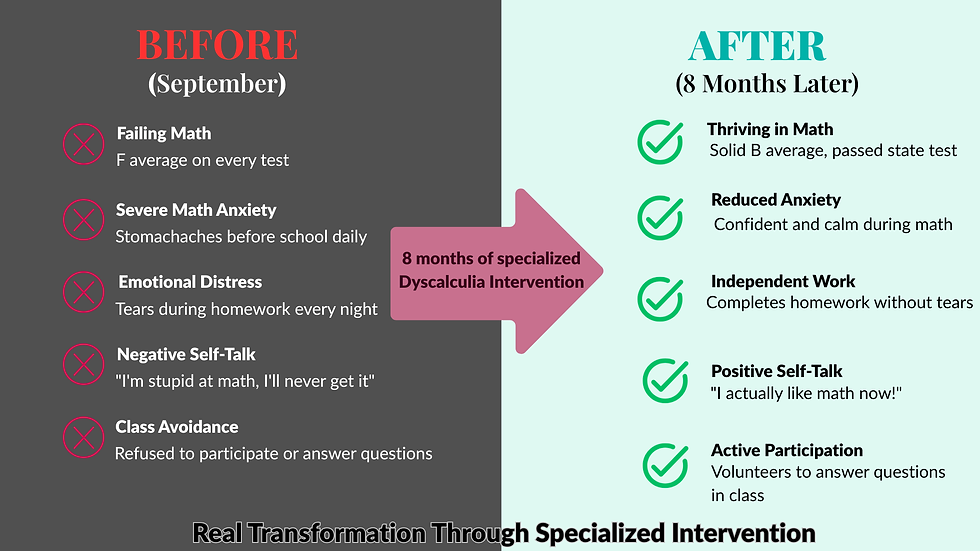
You've read about credentials, methodology, and timelines. Now let's talk about what actually happens when a struggling child gets the specialized support they need.
Case Study: Emma's Journey from Failing to Thriving
Meet "Emma" — 5th Grade, Diagnosed Dyscalculia
The Starting Point:
Consistent Fs in math (had never passed a math test)
Couldn't grasp place value despite years of instruction
Severe math anxiety: stomachaches before school, tears during homework every night
Said "I'm stupid at math" and refused to participate in class
What wasn't working:
School's "extra help" was just more worksheets
Previous tutor focused on memorizing procedures
Parents were frustrated and didn't know how to help
The Intervention:
Assessment revealed: Gaps back to 2nd-grade number sense
Approach: Started with concrete manipulatives (base-ten blocks, number lines); built place value understanding using CRA progression; multisensory activities every session; integrated confidence-building
Consistency: Twice-weekly sessions for 8 months; parent support at home; school accommodations (extended time, calculator, reduced homework)
The Results:
Timeline | Progress |
Month 2 | Stopped crying during homework; volunteered one answer in class (first time ever) |
Month 4 | Grade improved from F to C-; could explain her reasoning; reduced anxiety |
Month 6 | Grade improved to B-; completed homework independently; asked to join math club |
Month 8 | Solid B average; passed state test; said: "I actually like math now. I'm not stupid—I just needed someone to explain it differently." |
Long-term: Emma is now in 7th grade taking pre-algebra (on grade level). She still uses accommodations but is thriving. She's considering becoming a veterinarian—a career she never thought possible because "it requires math."
What Parents Are Saying
💬 "We finally found someone who gets it."
"My son has ADHD and dyscalculia, and most tutors couldn't handle both. MindBridge's approach integrates executive function coaching with math intervention—it's exactly what he needed. He's gone from refusing to do math to actually enjoying problem-solving."
— Parent of 8th grader, Texas
💬 "The difference is night and day."
"After six months of specialized tutoring, my daughter went from 2nd-grade math level to 5th-grade level. But the real win? She stopped saying 'I can't do this' and started saying 'Let me try a different way.' That mindset shift is everything."
— Parent of 5th grader, California
💬 "Worth every penny."
"Yes, specialized tutoring costs more. But watching my child go from daily math meltdowns to genuine confidence? Priceless. We're not just fixing grades—we're changing his entire relationship with learning."
— Parent of 6th grader, New York
The Common Thread: What Makes Transformation Possible
Looking across all these success stories, here's what they have in common:
✅ Specialized intervention (not generic tutoring)—tutors with dyscalculia-specific training and multisensory methodology
✅ Consistency over time—regular sessions for months/years, not weeks
✅ Addressing both skills and emotions—building number sense AND confidence
✅ Collaboration—between home, tutor, and school
✅ Patience and realistic expectations—understanding that transformation takes time
💡 What Success Really Looks Like
"People ask if my daughter is 'cured' of dyscalculia. No. She still processes numbers differently. But she has strategies, confidence, and access to her future. That's what success looks like."— Parent of high school student
You've seen what's possible. Now let's answer the remaining questions you might have in our comprehensive FAQ section.
Your Questions Answered: Comprehensive FAQ
You've learned a lot. But you probably still have questions. Here are the most common ones parents ask—with clear, honest answers.
❶ What qualifications should a dyscalculia tutor have?
Look for specialized training in dyscalculia intervention (Dr. Schreuder, Ronit Bird, Steve Chinn, Mahesh Sharma programs), multisensory math instruction certification (Marilyn Zecher, Math-U-See, TouchMath), and/or educational therapy credentials (NILD, AET).
Experience working specifically with dyscalculia students (not just "struggling math students") is essential. Advanced degrees in math education or special education are helpful but not sufficient alone—specialized training is key.
Bottom line: Don't settle for "I'm a certified teacher" or "I'm good at math." You need someone with dyscalculia-specific expertise.
❷ How is dyscalculia tutoring different from regular math tutoring?
Regular math tutoring focuses on:
Homework completion and test prep
Reteaching procedures and algorithms
Memorization and practice
Getting the right answer
Dyscalculia tutoring focuses on:
Building foundational number sense and conceptual understanding
Using multisensory, research-based interventions
Addressing underlying processing differences (how the brain perceives quantity and numerical relationships)
Using concrete manipulatives and the CRA (concrete-representational-abstract) progression
Integrating confidence-building and anxiety reduction
Teaching compensatory strategies for persistent challenges
The difference: Regular tutoring reteaches what didn't work. Dyscalculia intervention rebuilds the foundation using methods designed for how your child's brain actually works.
❸ Can online tutoring really work for dyscalculia?
Yes! When done properly with digital manipulatives, interactive whiteboards, and multisensory techniques, online tutoring is highly effective.
Benefits of online tutoring:
✅ Access to specialists nationwide (not limited by geography)
✅ Reduced anxiety (familiar home environment feels safer)
✅ Flexible scheduling
✅ Excellent digital tools (virtual manipulatives, screen-sharing, document cameras for physical manipulatives)
✅ Easier parent observation (you can see what's working)
Many students actually prefer online because it feels less intimidating than face-to-face, and they can access the best specialists regardless of location.
What matters: The tutor's expertise and methodology—not whether they're in the same room.
❹ How long does dyscalculia tutoring take to work?
Honest answer: It depends on the severity of gaps and consistency of intervention.
Typical timelines:
Short-term (1-3 months):
Reduced anxiety and avoidance
Increased engagement and willingness to try
Small conceptual breakthroughs ("Oh! That's what place value means!")
Medium-term (3-6 months):
Improved number sense and foundational skills
Better strategy use and problem-solving
Grade improvement (typically 1+ letter grades)
Long-term (6-12+ months):
Solid foundational skills
Independent problem-solving
Genuine confidence and positive math identity
Comprehensive intervention: Typically 1-3+ years for substantial, lasting change that addresses all foundational gaps and builds grade-level competence.
Important: Progress depends on:
Severity of initial gaps
Consistency of sessions (weekly/bi-weekly is ideal)
Co-occurring conditions (ADHD, dyslexia, anxiety)
Support at home and school
Bottom line: There are no quick fixes. But consistent, specialized intervention produces real, lasting change.
❺ What should dyscalculia tutoring cost?
Specialized dyscalculia tutoring typically ranges from $75-$200+ per hour, depending on:
Tutor credentials and years of specialized experience
Geographic location (even for online tutoring)
Session length and frequency
Package deals vs. per-session pricing
Why specialized tutoring costs more:
Years of specialized training (often $5,000-$15,000+ in professional development)
Intensive individualized lesson planning (30-60 minutes of prep per session)
Ongoing assessment and progress tracking
Smaller caseloads (15-25 students vs. 40+ for general tutors)
Financial options:
Insurance/FSA/HSA reimbursement (with Letter of Medical Necessity)
IEP funding (if school cannot provide adequate services)
Tutor payment plans and monthly packages
Sliding scale (some specialists offer limited spots)
Consider the ROI: Proper intervention prevents years of struggle, opens academic opportunities, and builds lifelong skills and confidence. The cost of NOT getting proper help is much higher.
❻ At what age should I start dyscalculia tutoring?
As soon as struggles are identified—even kindergarten or 1st grade.
Why early intervention matters:
❼ Can a tutor help with math anxiety too?
Absolutely. Specialized dyscalculia tutors address both skill gaps and emotional barriers—because they're interconnected.
How tutors reduce math anxiety:
✅ Multisensory, success-based approaches
Provide achievable wins that build genuine competence
Success reduces anxiety naturally
✅ Psychologically safe learning environment
Mistakes are learning opportunities, not failures
No judgment, no pressure, no shame
✅ Explicit anxiety-reduction strategies
Deep breathing before challenging problems
Breaking tasks into manageable chunks
Giving students control over pacing
Celebrating effort and strategy use
✅ Reframing the narrative
"Your brain works differently—not worse"
"Math is hard for you, AND you're getting better"
Building a growth mindset
Math anxiety and dyscalculia often co-exist. Effective intervention addresses both simultaneously—you can't build skills if anxiety is shutting down learning, and you can't reduce anxiety without building genuine competence.
❽ What if my child has dyscalculia AND ADHD or dyslexia?
Co-occurrence is common:
30-40% of students with dyscalculia also have ADHD
20-30% also have dyslexia
Many have multiple learning differences
The best tutors understand and address multiple learning differences with integrated approaches:
For dyscalculia + ADHD:
Multisensory instruction (keeps attention engaged)
Executive function coaching (organization, planning, self-monitoring)
Frequent breaks and movement
Scaffolded, structured lessons
Explicit strategy instruction
For dyscalculia + dyslexia:
Minimize reading demands in math (use visuals, verbal explanations)
Read word problems aloud
Focus on conceptual understanding (not reading-heavy procedures)
Multisensory techniques for both reading and math
For dyscalculia + anxiety:
Build confidence alongside skills
Reduce pressure and time constraints
Celebrate small wins
Teach self-regulation strategies
What to ask tutors: "What experience do you have with students who have both dyscalculia and [ADHD/dyslexia/anxiety]? How do you adapt your approach?"
Look for tutors who explicitly mention experience with co-occurring conditions and can describe how they integrate support.
❾ Will my child always need a tutor?
The goal is independence, not dependence.
Typical progression:
Phase 1 (Months 1-12+): Intensive intervention
Weekly or bi-weekly sessions
Building foundational skills and strategies
Addressing significant gaps
Phase 2 (Year 2-3): Transition to maintenance
Less frequent sessions (bi-weekly or monthly)
Support for new concepts and challenging topics
Check-ins to ensure strategies are working
Phase 3 (Long-term): Occasional support
As-needed sessions for new math levels (algebra, geometry, etc.)
Test prep or specific challenges
Many students "graduate" from regular tutoring but return for occasional support
Some students continue through high school for advanced math support—and that's okay. The investment builds lifelong strategies, not permanent reliance.
What matters: Your child develops:
Solid foundational skills
Compensatory strategies they can use independently
Confidence and self-advocacy
Understanding of how their brain works and what helps
Your Action Plan: Finding the Right Tutor for YOUR Child
You have all the information. Now it's time to take action.
Here's your simple, step-by-step plan to find a qualified dyscalculia tutor and get started:
Step 1: Assess Your Child's Needs (15-30 minutes)
Before you start searching, get clear on what your child needs:
Ask yourself:
Is dyscalculia formally diagnosed, or are we still exploring?
What specific areas are most challenging? (number sense, place value, fractions, word problems, math facts)
Are there co-occurring conditions? (ADHD, dyslexia, anxiety)
What's my child's current emotional state around math? (avoidance, anxiety, frustration, shutdown)
Action: Take our free dyscalculia screener to identify specific areas of difficulty
Step 2: Research 3-5 Potential Tutors (1-2 hours)
Use the resources from Section 3 to build your shortlist:
Where to look:
Specialized directories: AET, IDA, Dyscalculia.org, NCLD, LDA
Google search: "dyscalculia tutor online" + your state
Ask in parent support groups (Facebook, local learning disability organizations)
What to look for on their websites:
✅ Specific dyscalculia training listed
✅ Multisensory math certification
✅ Clear methodology explanation
✅ Specific student outcomes (not just generic testimonials)
✅ Blog or resources showing expertise
Action: Create a shortlist of 3-5 tutors who show true specialization
Step 3: Schedule Free Consultations (30-60 minutes total)
Most qualified tutors offer 15-20 minute discovery calls. This is your chance to vet them.
What to bring:
Your vetting checklist (download the PDF from Section 2)
Notes about your child's specific struggles
Questions about their approach
What to ask:
Focus on the top 6-8 questions from your checklist
Pay attention to how they talk about your child and dyscalculia
Ask about logistics (scheduling, pricing, cancellation policy)
What to observe:
Do they listen and ask thoughtful questions?
Can they clearly explain their methodology?
Do you feel confident in their expertise?
Does your gut say "yes, this person gets it"?
Action: Schedule consultations with your top 3 tutors
Step 4: Make Your Decision (Don't overthink it)
After consultations, compare your notes:
Consider:
✅ Credentials and specialized training
✅ Experience with your child's specific profile
✅ Clear, research-based methodology
✅ Communication style and rapport
✅ Logistics (scheduling, pricing, availability)
✅ Your gut feeling
Don't choose based on price alone. The cheapest option often costs more in the long run (wasted time, continued struggle).
Trust your instincts. If someone has the credentials but something feels off, keep looking.
Action: Select the tutor who best matches your child's needs and your family's situation
Step 5: Commit to Consistency (This is where transformation happens)
Once you've chosen a tutor, set yourself up for success:
Schedule regular sessions:
Weekly or bi-weekly is ideal (consistency matters more than intensity)
Put sessions on the calendar for the next 2-3 months
Treat them like doctor's appointments (non-negotiable)
Communicate openly:
Share observations from home and school
Ask questions when something isn't clear
Provide feedback about what's working
Be patient:
Progress takes months, not weeks
Celebrate small wins along the way
Trust the process even during plateaus
Support at home:
Use positive, neurodiversity-affirming language
Avoid timed pressure and "you should know this by now"
Celebrate effort and strategy use, not just correct answers
Action: Schedule your first session and commit to at least 3 months of consistent intervention before evaluating progress
What If You're Still Stuck?
If you need more information first:
Download our free comprehensive guide: "Dyscalculia Demystified" [Link]
Consider a formal dyscalculia assessment (educational psychologist)
Join parent support groups for recommendations
If you're overwhelmed by options:
Start with one consultation—you don't have to decide immediately
Ask for trial sessions (many tutors offer 1-2 before committing to packages)
Remember: finding the right fit might take a few tries, and that's okay
If cost is a barrier:
Ask about sliding scale or payment plans
Explore FSA/HSA reimbursement options
Investigate IEP funding if applicable
Consider that the cost of NOT getting help is much higher
The Bottom Line
Yes, finding a qualified dyscalculia tutor online is challenging.
But it's not impossible.
You now know:
✅ What credentials actually matter
✅ What questions separate specialists from generalists
✅ Where to find qualified tutors
✅ What red flags to avoid
✅ What effective intervention looks like
✅ What realistic progress timelines are
✅ How to support your child through the process
The difference between a general tutor and a dyscalculia specialist?
One reteaches what didn't work. The other rebuilds the foundation using methods designed for how your child's brain actually works.
Your child doesn't need "more of the same." They need someone who understands how their brain processes numbers differently—and knows exactly how to bridge that gap.
That specialist exists. And now you know how to find them.
Ready to Take the Next Step?
At MindBridge Math Mastery, we've built our entire practice around supporting students with dyscalculia and other math learning differences.
Our approach:
✅ Certified dyscalculia intervention (Dr. Schreuder)
✅ Multisensory math instruction (Marilyn Zecher, Levels 1 & 2)
✅ Educational therapy training (NILD)
✅ Master's in Math Education
✅ Years of specialized experience with dyscalculia, ADHD, and math learning differences
We integrate:
Concrete-representational-abstract (CRA) methodology
Multisensory techniques in every lesson
Executive function coaching
Confidence-building and math anxiety reduction
Individualized lesson plans based on ongoing assessment
We're not a homework help service. We're specialists in rebuilding foundational number sense for students whose brains process math differently.
📅 Schedule a Free 20-Minute Consultation
Let's talk about:
Your child's specific challenges
Whether our approach is the right fit
What specialized dyscalculia intervention can look like for your family
No pressure. No sales pitch. Just honest conversation about how we can help.

Susan Ardila is an educational therapist and math learning specialist with over 13 years of experience helping neurodiverse and high-achieving students thrive. She founded MindBridge Math Mastery to support families navigating dyscalculia, ADHD, and executive function challenges with evidence-based, multisensory approaches. When she’s not designing individualized learning plans, Susan is probably geeking out over number sense research, swapping strategies with other educators, or listening to her husband play his guitar.


Comments