


How Do Executive Function Difficulties Affect Math?


Last updated: August 2026
How Do Executive Function Difficulties Affect Math?
Executive function difficulties can affect math by making it harder to hold information in mind, follow steps, choose strategies, ignore distractions, and catch mistakes.
A student may understand the mathematical concept itself but still struggle to use that knowledge accurately, efficiently, or independently. That is because solving math problems requires much more than remembering formulas or knowing which operation to use. Students also have to manage information, organize their thinking, keep track of multiple steps, shift strategies when something is not working, and monitor their own accuracy along the way.
This distinction is especially important for parents and teachers to understand:
Knowing the math and managing the thinking required to do the math are not the same thing.
A student who repeatedly loses their place, skips steps, forgets what they were solving for, struggles to begin, or makes errors they can later correct may not simply need “more math practice.” In some cases, the obstacle may be the executive-function demands surrounding the mathematics rather than the mathematical concept itself.
Quick Answer
Executive functions are the cognitive processes that help us manage attention, information, behavior, and goal-directed tasks. Math places significant demands on these processes because students must often hold information in working memory, inhibit irrelevant responses, switch between strategies, organize steps, begin tasks, and monitor their own work. When these skills are difficult, a student may appear not to understand math even when the underlying concept is understood. Executive-function difficulties can occur on their own or alongside ADHD, autism, dyscalculia, or other learning differences. However, executive-function difficulties and dyscalculia are not the same thing.
TL;DR: Key Takeaways
Math requires more than mathematical knowledge. Students must also manage attention, memory, planning, organization, and self-monitoring while solving problems.
Executive functions help students manage the process of doing math. They support holding information in mind, sequencing steps, choosing strategies, resisting distractions, shifting approaches, beginning tasks, and checking accuracy.
Executive functioning is meaningfully related to mathematics achievement. Research consistently shows associations between executive-function skills and math performance.
Working memory appears to be especially important. Many math tasks require students to hold and manipulate information while simultaneously completing additional steps.
Executive-function difficulties can coexist with other learning differences. They are commonly discussed in connection with ADHD and autism and may also occur alongside dyscalculia or other learning disabilities.
More practice is not always the answer. If a student’s difficulty is partly related to working memory, organization, task initiation, or self-monitoring, simply assigning more problems may not address the actual barrier.
Effective math intervention should identify where the learning process is breaking down. Not every mistake means the student lacks mathematical understanding.
In This Article
What Are Executive Functions?
Executive functions are the mental processes we use to manage our thinking, behavior, and actions when we are trying to accomplish a goal. In other words, they help us figure out what we need to do, how we are going to do it, and how to keep ourselves on track long enough to actually finish it.
That matters a lot in math because students are rarely doing just one thing at a time. Even a fairly simple problem may require them to remember information, ignore distractions, choose a strategy, follow steps in the correct order, notice when something is not working, and check whether their answer makes sense.
Researchers do not all define executive functioning in exactly the same way, so you may see slightly different lists depending on the model being used. However, three areas show up very consistently in the research:
Working Memory
Working memory is the ability to hold information in your mind and work with it at the same time.
For example, a student solving a multi-step problem may need to remember an intermediate answer while completing the next step. If that information disappears from working memory too quickly, the student may lose their place, repeat a step, skip something important, or forget what they were solving for in the first place.
Inhibitory Control
Inhibitory control is the ability to stop an automatic, impulsive, or irrelevant response when it is not the right one for the situation.
In math, this may mean resisting the urge to immediately add just because a problem contains the word “more,” ignoring information that is not actually needed, or stopping long enough to read the entire problem before beginning to calculate.
Cognitive Flexibility
Cognitive flexibility, sometimes called shifting, is the ability to change strategies, rules, or perspectives when the situation changes.
A student may need to recognize that the strategy that worked on the last problem will not work on this one, move between different representations, or abandon an approach that is clearly getting them nowhere and try something else.
In educational settings, executive functioning is also often discussed more broadly to include skills such as planning, organization, task initiation, sustained attention, time management, and self-monitoring. These skills are closely connected to how students manage real academic tasks, even though researchers may group or define them somewhat differently depending on the framework they are using.
The important point is not memorizing a perfect list of executive functions. It is understanding that these skills help students manage the process of learning and problem solving.
And in math, that process matters just as much as knowing the content.
Why Does Math Require So Much Executive Function?
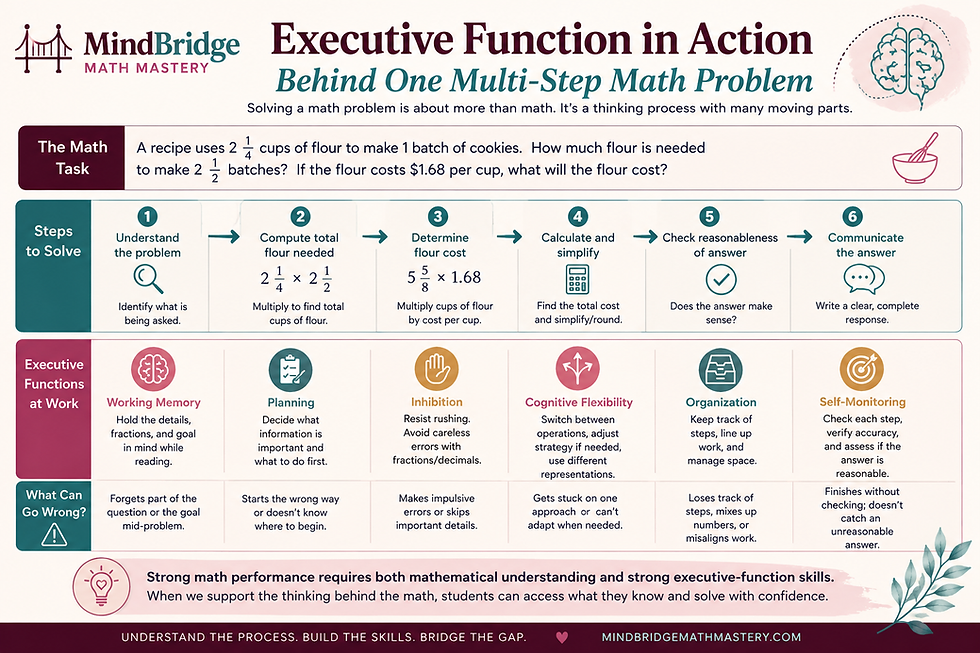
Math can place an enormous demand on executive functioning because students are often expected to do several different mental jobs at the same time. And as math becomes more complex, those demands tend to increase.
Take a fairly ordinary word problem:
A school is ordering 8 boxes of pencils. Each box contains 24 pencils. The pencils will be divided equally among 6 classrooms. How many pencils will each classroom receive?
Mathematically, this is not an especially complicated problem. A student needs to multiply 8 × 24 and then divide the result by 6.
But look at everything the student's brain actually has to manage to get there.
The student has to:
Read and understand the problem well enough to figure out what is happening.
Determine which information matters and what the question is actually asking.
Hold important numbers and information in working memory while deciding what to do with them.
Retrieve relevant math knowledge, such as multiplication and division facts or procedures.
Choose an appropriate strategy and recognize that this problem requires more than one operation.
Complete the steps in the correct order.
Resist jumping to an answer too quickly or using an operation simply because a certain number or word caught their attention.
Keep track of intermediate answers, including remembering that 192 pencils is not the final answer.
Change course if the original strategy is not working.
Monitor the final answer and ask whether 32 pencils per classroom actually makes sense.
That is a lot happening behind what looks like one relatively simple math problem.
And this is where we can easily misunderstand what a struggling student actually needs.
The Student's Mathematical Knowledge May Not Be the Only Bottleneck
A child can understand multiplication. They can understand division. They may even be perfectly capable of calculating 8 × 24 and 192 ÷ 6 when those problems are presented separately.
But put those same skills inside a multi-step problem that requires the student to determine what to do, remember what they are doing, keep track of where they are in the process, and monitor their own work, and suddenly that same student may struggle.
That does not automatically mean the child doesn't understand multiplication or division.
It may mean that the student understands the individual mathematical concepts, but the combined demands of the task are exceeding what they can efficiently manage at one time.
The same thing can happen at virtually every level of math. A younger student may lose track while regrouping during subtraction. A middle school student may know how to solve proportions but struggle to organize a multi-step word problem. An algebra student may understand equations but repeatedly lose negative signs or forget which step comes next. A geometry student may understand the individual theorems but struggle to organize the reasoning required for a proof.
This is why looking only at whether an answer is right or wrong tells us surprisingly little about what actually happened.
When I work with a student who gets a problem wrong, I am much more interested in where the process broke down. Did they misunderstand the mathematical concept? Did they forget a step? Lose information they were holding in mind? Choose the wrong strategy? Rush into a calculation? Get overwhelmed by how much information they were trying to manage? Or simply fail to notice an error they actually knew how to correct?
Those are very different problems, and they do not necessarily need the same intervention.
Sometimes the student needs help learning the math. Sometimes the student knows the math but needs support managing everything their brain has to do in order to use it. Very often, it is some combination of both.
What Does Research Actually Say About Executive Function and Math?
So far, I have explained why executive functioning can affect a student's ability to do math. But this is not simply something educators have noticed in the classroom. There is a substantial body of research examining the relationship between executive functioning and mathematical performance, and some of the strongest evidence comes from large-scale meta-analyses that combine findings across many individual studies.
And rather than simply telling you that something is “research-based,” I think it is much more useful to look at what the research actually found.
🔎 Research Spotlight: More Than 104,000 Students
A 2026 systematic review and meta-analysis examined 29 longitudinal studies involving 104,295 children and adolescents. Because these were longitudinal studies, researchers were looking at executive functioning and mathematical performance across different points in children's development, rather than simply taking a snapshot at one moment in time.
The researchers found a statistically significant relationship between overall executive functioning and mathematics performance of r = .30.
When they looked at individual executive-function components, the relationships were:
Working memory: r = .43
Cognitive flexibility: r = .34
Inhibitory control: r = .21
Of the executive functions examined, working memory had the strongest relationship with mathematics performance.
Now, those numbers need a little context because an r of .43 does not mean that working memory is responsible for 43% of a student's math ability. It is a correlation coefficient, which tells us about the strength and direction of the relationship between two variables.
More importantly, correlation does not prove causation. These findings do not mean that weak executive functioning automatically causes poor math performance, nor do they allow us to look at an individual child and conclude that executive functioning is the reason they are struggling.
What they do tell us is that the relationship between executive functioning and mathematics is substantial enough to show up consistently across very large groups of students.
Working Memory Keeps Showing Up
The particularly strong relationship between working memory and mathematics is not unique to that newer analysis.
In 2016, Peng, Namkung, Barnes, and Sun conducted a meta-analysis specifically examining mathematics and working memory. Their analysis included 110 studies and 829 effect sizes and found an overall correlation of r = .35 between working memory and mathematics.
But one of the most interesting findings was that the strength of this relationship depended somewhat on the type of math students were doing.
Working memory had particularly strong relationships with word-problem solving and whole-number calculation, while the relationship was weakest for geometry.
That makes sense when we think about what different mathematical tasks actually require from a student. A multi-step word problem, for example, can require a student to hold several pieces of information in mind while simultaneously interpreting language, selecting operations, performing calculations, and remembering what the original question was asking.
The Relationship Appears Across Other Large Reviews, Too
A 2019 meta-analysis by Cortés Pascual, Moyano Muñoz, and Quílez Robres examined 21 samples involving 7,947 elementary-age students.
They found an overall relationship of r = .365 between executive functioning and academic performance. When mathematics was examined specifically, the relationship was also r = .365.
Working memory was the most frequently studied executive-function component in their analysis and showed a relationship of r = .370 with overall academic performance.
Then, in 2021, Spiegel and colleagues conducted an even larger meta-analysis involving 299 studies representing 65,605 elementary-age children.
This study is particularly helpful because executive functions overlap with one another. A child with difficulty in one area may also struggle in another, which can make it difficult to determine whether we are really measuring the contribution of one executive function or some combination of several.
Spiegel and colleagues statistically accounted for those relationships and examined working memory, inhibitory control, and shifting together. As expected, the relationships became smaller once that overlap was taken into account.
But they did not disappear.
All three executive-function components continued to show significant relationships with academic outcomes across elementary school, and working memory remained moderately associated with mathematics throughout development.
This Is Not a Brand-New Idea
Researchers have been finding connections between executive functioning and mathematics for decades.
In a frequently cited 2001 study, Rebecca Bull and Gaia Scerif examined children's mathematical ability alongside measures of inhibition, switching, and working memory. Mathematical performance was significantly associated with several executive-function measures, and their analyses found that executive-function measures accounted for unique differences in mathematics performance.
That study was much smaller than the meta-analyses we have available today, but it helped establish an important line of research: mathematical performance is connected not only to what a student knows about numbers and procedures, but also to the cognitive processes used to manage mathematical thinking.
More than two decades later, much larger bodies of research continue to support that connection.
📌 What This Research Does and Does Not Tell Us
What the research DOES tell us:
Executive functioning is meaningfully associated with mathematical learning and performance. Working memory, in particular, has shown a consistent relationship with mathematics across multiple large analyses.
What the research DOES NOT tell us:
Executive functioning explains every math difficulty. It does not mean that every student who forgets a step has an executive-function deficit, that executive-function difficulties automatically indicate ADHD, or that improving executive functioning by itself will automatically improve mathematics.
And this distinction matters.
Math performance is complicated. Mathematical knowledge, number sense, language, prior instruction, attention, processing demands, executive functioning, learning disabilities, anxiety, and many other factors can interact.
The research gives us another very important piece of the puzzle. It does not give us permission to assume that every struggling student has the same puzzle.
That is exactly why I believe we have to look beyond whether a student got an answer right or wrong and determine where and why their mathematical process is breaking down.
Working Memory: Keeping the Math “Online”
Of all the executive functions we have discussed, working memory has one of the clearest and most consistent relationships with mathematics. And once you look at what students are actually expected to keep track of while solving a math problem, it is pretty easy to see why.
Working memory is essentially the mental workspace we use to temporarily hold information while doing something with it. It is not the same thing as remembering something you learned last week or memorizing a multiplication fact. Working memory is what allows a student to keep information “online” long enough to use it while completing a task.
Take a basic addition problem:
47 + 38
A student solving this with the standard algorithm may need to:
calculate 7 + 8 = 15;
write the 5 in the ones place;
remember that the 1 needs to be regrouped;
shift attention to the tens column;
add 4 + 3;
remember to include the regrouped 1;
and recognize that the final answer is 85.
For a student with efficient working memory, those tiny pieces of information may be managed so automatically that we barely notice they are there.
But imagine what happens if the regrouped 1 disappears from the student's mental workspace while they are adding the tens column.
They may write 75.
From the finished problem, it would be very easy to conclude that the student “doesn't know how to regroup.”
Except they might.
If I ask the student what happened, they may immediately look at the problem and say, “I forgot the 1.” They may even be able to explain the regrouping process perfectly.
That distinction matters because forgetting a step you understand is not necessarily the same problem as never understanding the step in the first place.
As the Math Gets Harder, the Working-Memory Load Gets Heavier
Now imagine what happens when we move from 47 + 38 to algebra.
A student solving:
3(x + 4) - 5 = 19
has to keep track of considerably more information. They need to remember the goal of isolating the variable, apply operations correctly, keep track of what they have already done, maintain signs and intermediate results, and decide what should happen next.
A student can absolutely understand the distributive property and still forget to distribute the 3 to both terms. They can understand inverse operations and still lose a negative sign halfway through the problem. They can know every individual skill involved and still become lost somewhere in the sequence.
A multi-step word problem can place an even greater demand on working memory because now the student may also be juggling language and mathematical information at the same time.
They have to remember what happened in the problem, decide which numbers are relevant, determine what the question is asking, select a strategy, perform calculations, retain intermediate answers, and somehow keep the original goal from disappearing while they are doing all of that.
This is one reason a student can sometimes complete individual calculations perfectly but struggle when those exact same calculations are embedded inside a longer problem.
What Working-Memory Difficulties Can Look Like in Math
Parents and teachers may notice that a student:
frequently loses their place during multi-step problems;
forgets intermediate answers before they can use them;
repeatedly rereads the same part of a word problem;
gets halfway through a problem and forgets what they were trying to find;
knows a procedure but randomly leaves out steps;
follows a process successfully with guidance but struggles to reproduce it independently;
has much more difficulty with mental math than when information is written down;
makes errors involving regrouping, signs, operations, or other information they actually know;
becomes increasingly overwhelmed as problems get longer or contain more steps.
None of these behaviors, by themselves, prove that a student has weak working memory. But they can give us important information about where to look when a student's performance doesn't seem to match what they appear to understand.
🔎 Research Spotlight: Working Memory and Mathematics
The research we discussed earlier makes working memory particularly difficult to ignore.
In the recent longitudinal meta-analysis of 29 studies and 104,295 children and adolescents, working memory had the strongest relationship with mathematics performance of the executive functions examined, at r = .43.
Similarly, Peng, Namkung, Barnes, and Sun's 2016 meta-analysis of 110 studies and 829 effect sizes found an overall relationship of r = .35 between working memory and mathematics. Their analysis also found that the relationship varied by the type of mathematics being performed, with stronger relationships for areas such as word-problem solving and whole-number calculation and a weaker relationship for geometry.
That does not mean working memory determines how good a child will be at math. It does tell us that working memory is consistently related to mathematical performance across a very large body of research.
And from an instructional standpoint, that matters.
If working memory is part of the bottleneck, we do not necessarily want to keep asking the student to hold more information in their head.
We can put some of that information somewhere else.
Writing down intermediate answers, providing visual steps, using worked examples, organizing information on the page, breaking longer tasks into manageable pieces, and giving students appropriate reference tools can all reduce unnecessary demands on working memory.
The goal is not to make the mathematics easier or to do the thinking for the student. It is to make sure that working-memory overload is not preventing the student from demonstrating mathematical thinking they are actually capable of doing.
For a deeper explanation of working memory, how it affects mathematics, and strategies for supporting it, see my related article on How Working Memory Affects Math Success.
Inhibitory Control: Stopping the Wrong Answer Before It Happens
When people hear inhibitory control, they often think it simply means paying attention or resisting distractions. That is part of the picture, but in math, inhibition has another very important job: helping students stop themselves from using the first response that comes to mind when that response is not appropriate.
Math is full of situations where the brain's first instinct is not necessarily the correct one.
Consider:
8 + 4 × 3
A student may immediately begin by calculating 8 + 4 because we have spent years teaching children to read and process information from left to right.
But mathematics has another rule operating here. The student has to recognize the multiplication, inhibit the automatic left-to-right response, apply the order of operations, and calculate 4 × 3 before adding 8.
What makes this particularly interesting is that a student can know the order of operations perfectly well and still make this mistake.
Ask them, “What do we do first?” and they may immediately tell you, “Multiplication.”
So why didn't they do it?
Because knowing a rule and stopping an automatic response long enough to apply that rule are two different demands.
Math Is Full of Answers Students Have to Not Choose
Inhibitory control becomes even more important when students have learned several strategies, rules, or operations that could potentially apply.
Students may need to suppress:
information in a word problem that is irrelevant to the question;
a strategy that worked on the previous problem but does not apply to the current one;
an impulsive answer before fully reading the problem;
a familiar procedure triggered by the way a problem looks;
an operation suggested by a keyword even when the actual mathematical relationship requires something different.
That last one is a particularly common problem.
Suppose a student reads:
Mia has 8 stickers. She has 3 more stickers than Noah. How many stickers does Noah have?
A student who has been taught to rely heavily on keywords may see “more” and immediately think:
8 + 3 = 11
But Noah does not have 11 stickers. He has 5.
The student has to understand the relationship between the quantities and recognize that although the word more appears in the problem, addition is not the appropriate operation for answering the question.
That requires more than computation. The student must inhibit an automatic association long enough to reason about what the problem actually means.
This is also one reason I am not a fan of teaching students that certain words automatically tell them which operation to use. Keywords can sometimes be helpful clues, but when they become a substitute for understanding the mathematical relationship, they can create an entirely different problem later.
When “Careless” Isn't Quite the Right Word
This is where inhibitory control can become especially important for parents because some of these errors are often described as careless mistakes.
A student:
answers before reading the entire question;
uses the operation from the previous problem;
overlooks a negative sign;
applies a familiar rule where it does not belong;
grabs onto one piece of information and ignores the rest;
recognizes an error immediately when someone asks them to look again.
It is tempting to respond with, “You knew that. You just weren't paying attention.”
And sometimes, frankly, a student wasn't paying attention. Not every incorrect answer has a deeper explanation hiding underneath it.
But when the same kinds of errors happen repeatedly, especially when a student can explain the correct concept immediately afterward, it is worth looking more closely at what is happening between knowing the correct response and actually producing it.
Inhibitory control may be part of that process. Self-monitoring, which we will discuss later, may also play a role.
The important point is that an impulsive error does not automatically mean a student lacks mathematical understanding.
At the same time, we should not swing too far in the other direction and assume every “careless” mistake is caused by executive-function difficulties. Errors can come from incomplete conceptual understanding, misconceptions, insufficient practice, language difficulties, anxiety, distraction, rushing, or any number of other factors.
Once again, the mistake itself only tells us what went wrong.
To help the student effectively, we need to figure out why it went wrong.
Cognitive Flexibility: When the First Strategy Doesn't Work
Math would be much easier if every problem announced exactly which strategy to use.
Unfortunately, it doesn't.
As students move beyond basic computation, they are increasingly expected to decide which mathematical idea applies, which representation is useful, whether a familiar strategy still works, and what to do when their first approach gets them nowhere.
That is where cognitive flexibility, sometimes called shifting, becomes particularly important.
Cognitive flexibility is the ability to shift between strategies, rules, representations, operations, or ways of thinking when the situation requires it. In math, students are constantly being asked to make these shifts, often without anyone explicitly pointing out that they are doing it.
For example, a student may need to:
recognize that 1/2, 0.5, and 50% represent the same quantity even though they look completely different;
move from thinking additively to thinking multiplicatively;
recognize that a problem that looks almost identical to the previous one actually requires a different operation or strategy;
abandon a strategy that is technically possible but unnecessarily complicated;
move between an equation, table, graph, diagram, or concrete model;
understand that two very different-looking solution methods can both be mathematically valid.
When a Familiar Strategy Stops Working
One of the easiest ways to see cognitive flexibility in action is to watch what happens when students encounter a problem that looks familiar but behaves differently.
For years, students learn that multiplication makes numbers larger and division makes numbers smaller.
Then fractions arrive.
Suddenly:
8 × 1/2 = 4
and
8 ÷ 1/2 = 16
The student's previous understanding was not completely useless. It worked within the whole-number situations they had encountered. But now they have to revise that understanding and become flexible enough to accommodate a broader mathematical idea.
The same thing happens throughout mathematics.
Students who have learned that subtraction means “take away” eventually encounter comparison problems where nothing is physically being removed. Students who have learned that the equal sign means “the answer comes next” have to understand it as a statement of equivalence. Students who have successfully solved equations one way may encounter a problem where another approach is much more efficient.
Mathematical understanding develops partly through these shifts.
Flexible Thinking Is More Than Knowing Multiple Strategies
This is also why I don't consider a student mathematically flexible simply because they have been taught five different ways to solve the same problem.
Knowing several strategies is useful.
Knowing when and why to use them is much more important.
A student might know how to draw a model, create a table, write an equation, use mental math, and apply a standard algorithm. But if they cannot recognize which approach makes sense for the problem in front of them, all of those strategies become a toolbox they cannot efficiently navigate.
On the other hand, some students become so attached to one successful strategy that they continue using it long after it stops being efficient.
You may see a student:
insist on using the same procedure for every problem;
become stuck when a problem is presented in an unfamiliar format;
struggle to connect a visual model to the corresponding equation;
continue with an approach that clearly is not working;
become frustrated when asked to solve something a different way;
understand concepts separately but struggle to recognize the connections between them.
Again, none of these behaviors automatically indicate a cognitive-flexibility difficulty. But persistent rigidity in mathematical thinking can give us another clue about where the problem-solving process may be breaking down.
🔎 Research Spotlight: Cognitive Flexibility and Mathematics
Cognitive flexibility also has measurable links to mathematical performance.
A meta-analysis examining 23 studies involving 35,355 children found a significant positive relationship between cognitive flexibility and mathematics performance of approximately r = .35.
Interestingly, the researchers found that the relationship was stronger among younger children.
That does not mean cognitive flexibility accounts for 35% of mathematical ability, nor does the correlation establish that cognitive flexibility directly causes stronger math performance. What it does provide is additional evidence that the ability to shift thinking is meaningfully related to how children perform mathematically.
And that makes sense when we consider what mathematics eventually asks students to do.
The goal is not simply to teach a student one successful procedure and hope every future problem fits neatly inside it. We want students to develop mathematical knowledge that is connected and flexible enough to use in different situations.
Sometimes that means trying another strategy.
Sometimes it means seeing the same quantity in a completely different representation.
And sometimes it means realizing:
“The way I solved the last problem isn't going to work here.”
Being able to make that shift is part of becoming an independent mathematical thinker.
Planning, Organization, and Sequencing

This is where executive-function difficulties can become much easier to recognize because we are moving away from what is happening invisibly inside a student's head and into what parents and teachers can actually see on the page.
Math frequently requires students to answer three questions before they can even get to the calculation:
Where do I start? What comes next? What information actually matters?
For some students, knowing the mathematics is not necessarily the hardest part. The difficulty is organizing everything they know into a workable plan and then carrying that plan through in the correct sequence.
Think about solving a multi-step equation. A student might understand inverse operations, combining like terms, and the distributive property individually. But when all three appear in the same equation, they have to determine which step should come first, keep their work organized, maintain equivalence from one line to the next, and continue making decisions until the variable is isolated.
Or consider long division.
The student has to divide, multiply, subtract, bring down, and then repeat the sequence. Knowing how to perform each individual operation does not necessarily mean the student can independently organize and maintain the entire sequence without losing their place.
And by the time students reach geometry proofs, the planning demands become even more obvious. A student may know the definitions, postulates, and theorems perfectly well but still stare at the proof and have absolutely no idea where to begin.
The question is no longer simply:
“Do you know this theorem?”
It becomes:
“Can you determine when this theorem is useful, connect it to the information you have been given, and organize several pieces of reasoning into a logical sequence that gets you from what you know to what you are trying to prove?”
Those are very different demands.
Word Problems Add Another Layer of Organization
Word problems can be particularly challenging because the student has to organize information before they even begin calculating.
They may need to:
identify what the problem is asking;
separate relevant information from irrelevant details;
determine how the quantities are related;
decide which operation or strategy makes sense;
determine whether more than one step is required;
complete those steps in a logical order;
keep track of intermediate answers;
return to the original question to make sure they actually answered it.
A student can perform every calculation correctly and still solve the problem incorrectly because they organized the information or sequence incorrectly.
This becomes even more demanding with multi-part assignments. A student may need to complete Part A before using that answer in Part B, keep several pieces of information organized across a page, or return to information from an earlier question.
At that point, the student isn't simply doing math.
They are managing a mathematical task.
Sometimes the Organization Problem Is Literally on the Page
Math also has a spatial organization component that we do not always appreciate until it starts causing problems.
Place value needs to stay aligned.
Decimal points need to stay aligned.
Numbers in long division have to be positioned correctly.
Negative signs need to remain attached to the correct quantities.
Equivalent steps in algebra need to be organized clearly enough that the student can follow their own reasoning.
Fractions need to be written in a way that makes the numerator and denominator relationships clear.
A student's page can become so visually disorganized that their own written work begins creating additional cognitive demands.
If intermediate calculations are scattered around the page, numbers are squeezed into random spaces, steps are missing, and the student cannot tell which calculation belongs to which problem, they now have to spend additional mental energy simply figuring out what they already did.
For a student who is already using a great deal of working memory to solve the mathematics, that extra demand matters.
A Messy Page Does Not Automatically Mean an Executive-Function Problem
This distinction is important.
Some kids just have messy handwriting.
Some rush.
Some hate showing their work.
Some can make a page look like a mathematical crime scene and still know exactly where everything is. 😅
So I would never look at one disorganized worksheet and conclude that a student has an executive-function difficulty.
What becomes more meaningful is a persistent pattern in which difficulties with planning, organization, or sequencing interfere with the student's ability to complete mathematics accurately or independently.
For example, a student may repeatedly:
know the individual skills but not know where to begin;
perform steps correctly but put them in the wrong order;
lose track of which part of a multi-step problem they are completing;
scatter calculations around the page and then struggle to locate their own work;
omit steps they know how to perform;
become overwhelmed when several pieces of information must be organized at once;
require someone else to repeatedly tell them what to do next.
In those situations, simply reteaching the mathematical procedure may not address the entire problem.
Sometimes the student needs support externalizing the organization that other students may be managing internally. That might mean explicitly planning a solution before calculating, visually separating steps, organizing information into a diagram or table, using consistent layouts, or creating a structure the student can gradually learn to use independently.
The goal is not to make every student's paper perfectly neat.
The goal is to make sure the student can organize mathematical information well enough that the organization itself does not become another obstacle to solving the problem.
Task Initiation: “They Know How to Do It, So Why Won't They Start?”
This can be one of the most frustrating situations for parents because you are looking at a child who knows how to do the work.
You have seen them do it before. Their teacher has seen them do it. Maybe they completed nearly identical problems yesterday.
And yet today they are sitting there staring at the page.
Ten minutes go by.
Nothing.
You remind them to start. They tell you they don't know what to do. You explain the directions again. They still don't start. Eventually everyone is frustrated, and what began as a math assignment turns into an argument about effort, motivation, or why something that should have taken 20 minutes has somehow taken over the entire evening.
Sometimes the problem really is that the student doesn't understand the math.
But sometimes there is an important difference between:
“I can't do this problem.”
and
“I can't efficiently get myself started on everything I need to do to solve this problem.”
That second problem involves task initiation.
Task initiation is the ability to begin a task without requiring excessive prompting and to move from knowing that something needs to be done to actually engaging in the actions necessary to do it.
And math can create a particularly high barrier to getting started because the first step is not always obvious.
Starting a Math Problem Is Actually a Decision
Imagine giving a student a worksheet containing 20 straightforward multiplication problems.
There is not much planning required to begin. Start with number one and multiply.
Now give that same student a complicated word problem.
Before writing anything, they may need to figure out:
What is this problem asking me?
What information matters?
What kind of problem is this?
Which strategy should I use?
Is there more than one step?
What should I write down first?
For a student who already has difficulty initiating tasks, that number of decisions can create a significant barrier before any actual calculation has happened.
The same thing can happen with a long homework assignment. A student looks at two pages of problems, mentally processes the entire assignment at once, becomes overwhelmed by how much there is to do, and does...nothing.
From the outside, that can look like procrastination or refusal.
The student may:
stare at the page without beginning;
repeatedly ask, “What do I do?” even after directions have been explained;
avoid assignments that look long or complicated;
procrastinate despite being capable of completing the work;
depend on an adult to tell them when and how to begin;
become overwhelmed before attempting the first problem;
appear completely “unmotivated” until someone helps them get started.
And once they finally start?
Sometimes they are perfectly capable of doing the math.
That difference gives us useful information.
Difficulty Starting Is Not Automatically Laziness
I think we have to be particularly careful with the language we use around task initiation because students who struggle in this area are very quickly described as lazy, unmotivated, oppositional, or unwilling to try.
Sometimes students absolutely do avoid work they simply don't want to do. Children are still human beings, and none of us enthusiastically approaches every task put in front of us.
But persistent difficulty initiating work is not automatically evidence of defiance or laziness.
It is also not automatically evidence of an executive-function problem.
A student may avoid beginning because the math is genuinely too difficult, because they are anxious about getting it wrong, because previous experiences have taught them to expect failure, because the directions are unclear, because they are exhausted, or because the assignment feels overwhelming for any number of reasons.
That is why the question should not immediately be:
“Why won't this child do the work?”
Sometimes a much more useful question is:
“What is making it difficult for this child to begin?”
If the barrier is task initiation, support may involve making the first action extremely clear, breaking larger assignments into visible starting points, reducing the number of decisions required at once, or helping the student develop a repeatable routine for approaching unfamiliar problems.
The goal is not for an adult to sit beside the student forever saying, “Okay, now do this. Now do this. Now do this.”
The goal is to gradually help the student develop a process they can initiate without needing another person to function as their external starting button.
Self-Monitoring: Catching Errors Before Turning In the Work
Then we have the student who finishes the assignment.
Great.
Except they have dropped two negative signs, copied a 6 as an 8, answered 14 of the 15 questions, switched operations halfway through one problem, and somehow concluded that a person bought 437 watermelons at the grocery store without finding that remotely suspicious.
And when you point to one of the mistakes and say, “Take another look at this,” they immediately fix it.
That can be maddening because the student very clearly knows better.
This is where self-monitoring becomes important.
Self-monitoring is the ability to keep track of your own performance while you are working and recognize when something needs your attention or correction.
In math, that can mean noticing:
that an answer is unreasonable;
that a question was accidentally skipped;
that a negative sign disappeared between two lines;
that the operation changed halfway through a calculation;
that the answer is nowhere near the estimate you made beforehand;
that a number was copied incorrectly;
that two lines of an equation are no longer equivalent;
or exactly where a multi-step procedure went off track.
Knowing How to Check Your Work Is Not the Same as Actually Checking It
This distinction comes up constantly.
A student can know how to check their work without consistently remembering to stop and actually do it.
If I ask, “How could you check that answer?” the student may immediately tell me.
They know they could substitute the solution back into the equation.
They know they could estimate first.
They know they could use the inverse operation.
They know they should reread the original question.
They know all of it.
The problem is that none of those strategies help if the student never independently pauses long enough to use them.
Self-monitoring has to happen while the student is solving the problem or before they decide they are finished.
And that can be surprisingly difficult because solving the problem and monitoring the process are essentially two jobs happening at once.
The student has to do the math while also periodically stepping outside of the process enough to ask:
Does this make sense?
This Is Where Many “Careless Mistakes” Live
Parents often tell me some version of:
“They know how to do this. They just make so many careless mistakes.”
And sometimes that description is completely understandable. The student really did know the math, and the error really was something they could have caught.
But careless describes what the mistake looks like. It does not necessarily explain why it happened.
A student who repeatedly drops negative signs, skips questions, copies numbers incorrectly, or fails to notice unreasonable answers may be struggling with self-monitoring, inhibition, attention, working-memory demands, or some combination of those factors.
Or they may simply have rushed through the assignment because they wanted to be done.
Again, not every careless mistake is an executive-function problem.
What I pay attention to is the pattern.
Does the student make the same kinds of errors repeatedly despite understanding the underlying concept? Can they correct those errors immediately when their attention is directed back to them? Do they know appropriate checking strategies but rarely initiate them independently? Does accuracy improve dramatically when someone else provides prompts such as, “Check your signs,” or “Does that answer make sense?”
Those observations can tell us considerably more than simply counting how many problems the student got wrong.
The Goal Is Not “Check Everything Three Times”
Telling a student to “check your work” is also not particularly helpful if we have never taught them what checking their work actually means.
For some students, “check your work” means staring at the exact same calculations for another 30 seconds and deciding they still look fine.
Effective self-monitoring needs to be specific and purposeful.
Depending on the mathematics, that might mean:
estimating before solving and comparing the final answer to the estimate;
substituting a solution back into an equation;
using an inverse operation;
checking signs before moving to the next line;
rereading the question and comparing it to the answer;
identifying whether every part of a multi-part problem was completed;
asking whether the magnitude of an answer is reasonable.
Over time, the goal is for these checks to become increasingly internalized so the student does not need another person constantly standing nearby asking, “Are you sure?”
Because ultimately, independent mathematical problem solving requires more than arriving at an answer.
It requires being able to notice when your own answer deserves a second look.
What Can Executive Function Difficulties Look Like During Math?
One of the reasons executive-function difficulties can be so easy to miss in math is that they do not always look like executive-function difficulties.
They can look like carelessness.
They can look like a student doesn't know the material.
They can look like procrastination, disorganization, rushing, giving up too quickly, or needing far more help than you would expect based on what the student seems to understand.
And sometimes those explanations are accurate.
But sometimes what we see on the surface is only the end result of something that broke down earlier in the problem-solving process.
The table below is not meant to diagnose anything. Instead, it gives parents and teachers another way to think about common math behaviors and some of the executive-function demands that may be contributing to them.
What Parents or Teachers May See | What May Be Happening |
Makes frequent “careless” mistakes despite knowing the concept | Difficulty with inhibitory control or self-monitoring may make it harder to slow down, notice errors, or stop an automatic response |
Forgets steps in procedures they have previously learned | Working-memory overload may cause information or steps to drop out while the student is solving |
Takes an unusually long time to complete math | Planning, task initiation, working memory, organization, or other processing demands may be increasing the amount of effort required |
Knows what to do but cannot seem to get started | Task initiation or planning may be creating a barrier between understanding the assignment and beginning it |
Gets lost in word problems | The combined demands of working memory, inhibition, language processing, planning, and mathematical reasoning may overwhelm the student's ability to keep everything organized |
Uses the wrong strategy even though they know several strategies | Cognitive flexibility or strategy selection may make it difficult to determine which approach fits the current problem |
Work is scattered all over the page | Organization and planning may be making it difficult to arrange mathematical information in a way the student can easily follow |
Understands when someone works alongside them but struggles alone | The adult's prompts, questions, structure, or reminders may currently be carrying part of the executive-function load |
Gives up when the first strategy does not work | Difficulty with cognitive flexibility/shifting may make it harder to abandon one approach and generate another |
Rarely checks answers or misses errors they know how to correct | Self-monitoring may not be happening consistently or independently |
These Behaviors Are Clues, Not Diagnoses
This is probably the most important part of this entire table:
“May be happening” does not mean “this is definitely the cause.”
If a student forgets steps, that does not automatically mean they have a working-memory deficit.
If they cannot start their homework, that does not automatically mean they have difficulty with task initiation.
If their work is disorganized, that does not automatically mean they have an executive-function disorder.
And making careless mistakes certainly does not automatically mean a student has ADHD.
The same observable behavior can have several completely different causes.
A student may get lost in a word problem because working-memory demands are too high. Another student may struggle because they do not understand the language. Another may not understand the mathematical relationship. Another may have weak number sense. And another may understand everything perfectly well but rush because they want to finish the assignment as quickly as humanly possible.
They all got the problem wrong.
They did not necessarily get it wrong for the same reason.
This is exactly why I am cautious about looking at a list of symptoms and trying to work backward into a label. What a student does gives us useful information, but we still have to determine why they are doing it.
Pay Attention to Patterns, Not Isolated Mistakes
What becomes much more useful is looking for patterns across time, tasks, and situations.
For example:
Does the student consistently perform better when steps are written down?
Does accuracy improve when someone reminds them to slow down and check specific parts of their work?
Can they explain a concept correctly immediately after making an error?
Do they struggle significantly more as the number of steps increases?
Does performance improve when information is visually organized or broken into smaller pieces?
Can they solve individual skills correctly but struggle when several of those same skills are combined into one problem?
Do they become much more successful when an adult is sitting beside them asking questions such as, “What are you trying to find?” “What should you do first?” or “Does that answer make sense?”
Those patterns begin to tell us something that a percentage at the top of a worksheet cannot.
And that is really the point of looking at executive functioning in math in the first place.
The goal is not to explain every mistake with executive function. The goal is to understand the student's learning process well enough to identify what is actually getting in the way.

Executive Function Difficulties vs. Dyscalculia
Because executive-function difficulties can affect math so significantly, it is easy to see why they sometimes get confused with dyscalculia. A student may forget procedures, struggle with multi-step problems, work very slowly, make frequent errors, or have difficulty applying skills independently.
Those behaviors can certainly occur in a student with dyscalculia.
But they can also occur for entirely different reasons.
Are Executive Function Difficulties the Same as Dyscalculia?
No. Executive-function difficulties and dyscalculia are not the same thing.
Dyscalculia is a specific learning difficulty involving persistent problems learning and understanding mathematics. Depending on the student, this may include difficulties developing number sense, understanding numerical magnitude and relationships, learning arithmetic facts, accurately or fluently calculating, and developing mathematical reasoning.
Executive functions, on the other hand, are the broader cognitive processes we have been discussing throughout this article. They help us hold and manipulate information, inhibit inappropriate responses, shift strategies, plan, organize, initiate tasks, and monitor our own performance.
And these processes are certainly not limited to math.
A student who struggles with executive functioning may also have difficulty organizing a writing assignment, beginning a long-term project, remembering several verbal directions, keeping track of materials, managing time, or checking their work in other subjects.
A student with dyscalculia may have very specific and persistent difficulties with mathematics even when some of those broader executive-function skills are relatively strong.
But Dyscalculia and Executive-Function Difficulties Can Coexist
Of course, these are not mutually exclusive categories.
A student can have dyscalculia and difficulties with working memory, planning, inhibition, organization, or other executive functions.
A student can have ADHD and dyscalculia.
A student can have executive-function difficulties without dyscalculia.
And a student can struggle significantly with mathematics for reasons that fit neatly into none of those categories.
This is why I don't think we can look at one behavior, or even a handful of behaviors, and confidently decide what is causing a student's math difficulty.
The Same Mistake Can Come From Two Completely Different Problems
Imagine two students who repeatedly forget steps when solving a math procedure.
From the outside, they may look almost identical.
Student A has never developed a strong conceptual understanding of the mathematics underneath the procedure. They are trying to remember a sequence of disconnected steps because the numbers, symbols, and operations do not have enough meaning attached to them.
When they forget the procedure, they have very little mathematical understanding to fall back on.
Student B, however, understands the concept.
They can explain why the procedure works. They can demonstrate it with a visual model. They may even be able to tell you exactly what they were supposed to do after they make the mistake.
But while solving independently, they lose one of the steps because too much information is competing for space in working memory.
On the worksheet, both students may have made the exact same error.
But I would not necessarily teach those two students the same way.
Student A may need the mathematics rebuilt conceptually so that the procedure is connected to meaning rather than memorized as a string of arbitrary steps.
Student B may need support reducing unnecessary working-memory demands, externalizing steps, organizing information, and gradually developing a system for managing the procedure independently.
And then there is Student C, because education never lets anything remain that tidy.
Student C may have both problems.
They may have weak conceptual foundations and executive-function difficulties that make it even harder to learn, organize, retrieve, and apply new mathematical information.
That is why simply identifying that a student “forgets the steps” is not enough.
Dyscalculia Is More Than Forgetting Math
This distinction is especially important because dyscalculia sometimes gets reduced to a list of surface-level symptoms:
Forgets math facts.
Mixes up numbers.
Struggles with word problems.
Can't remember procedures.
Those things may occur with dyscalculia, but none of them individually defines it.
If we focus only on what the difficulty looks like, we risk missing the underlying mathematical learning problem.
Likewise, if we assume every student who understands a concept but makes repeated execution errors has dyscalculia, we may be overlooking working memory, attention, self-monitoring, language, anxiety, instructional history, or other factors affecting performance.
The Question I Care About Is “Why?”
This brings us back to the distinction running throughout this article:
Knowing the math and managing the thinking required to do the math are not the same thing.
But they are not completely separate, either.
Mathematical understanding and executive functioning interact while a student is learning and solving problems. If one part of that system is struggling, it can affect what we see from the outside.
That is why effective intervention should not stop at:
“What did the student get wrong?”
We also need to ask:
Why did they get it wrong?
Did they misunderstand the mathematical concept?
Are foundational number relationships weak?
Did working memory become overloaded?
Did they choose an inappropriate strategy?
Did they lose their place?
Did they understand the problem but struggle to organize the steps?
Is more than one of these things happening at the same time?
Those answers matter because effective intervention depends on identifying the source of the difficulty, not simply correcting the visible error.
For a deeper explanation of dyscalculia, common signs, and how specialized math intervention differs from traditional tutoring, visit my Dyscalculia Tutoring & Math Intervention page.
ADHD, Executive Function, and Math
ADHD deserves its own discussion here because executive functioning and ADHD are closely related, but they are not interchangeable terms.
Not every student with executive-function difficulties has ADHD, and not every student with ADHD has the same executive-function profile. ADHD can affect students very differently, which is one reason two children with the same diagnosis can look completely different in a math classroom.
One student may understand the math but work so quickly that they make frequent errors. Another may take an extremely long time to complete the same assignment. One may struggle to begin. Another starts immediately but jumps between problems without finishing them. One may constantly lose their place during multi-step work, while another has no obvious difficulty until the mathematical demands become much more complex.
The diagnosis may be the same.
The actual barrier to learning may not be.
Can ADHD Affect Math Even if a Child Doesn't Have Dyscalculia?
Yes. A child can have ADHD-related difficulties with math without having dyscalculia.
ADHD is frequently associated with difficulties in executive functioning, although executive-function strengths and weaknesses vary considerably from one person to another. Because math relies so heavily on those processes, difficulties with executive functioning can interfere with mathematical performance even when a student's underlying mathematical understanding is relatively strong.
For example, ADHD may affect a student's ability to manage:
Sustained effort: remaining mentally engaged through longer or repetitive math tasks, particularly when the work requires significant effort or provides little immediate feedback.
Working memory: holding numbers, instructions, intermediate answers, or steps in mind while continuing to solve.
Inhibitory control: slowing down before responding, resisting an automatic strategy, or ignoring irrelevant information.
Task initiation: moving from knowing that an assignment needs to be completed to actually beginning it.
Organization: keeping calculations, materials, steps, and assignments organized well enough to manage the task efficiently.
Self-monitoring: noticing skipped questions, dropped signs, unreasonable answers, or errors that the student actually knows how to correct.
This can create a frustrating situation in which a student's math performance does not consistently reflect what they seem to know.
They may solve a difficult problem correctly and then miss an easier one.
They may demonstrate complete understanding during a lesson and appear to “forget everything” when working independently.
They may explain exactly how to solve a problem and then make three avoidable errors while actually solving it.
They may perform very differently depending on how long the assignment is, how much information they have to manage, how much structure is provided, or whether someone is sitting beside them helping them stay on track.
That inconsistency can make it tempting to assume the student simply needs to try harder.
But inconsistent performance does not necessarily mean inconsistent knowledge.
Sometimes the student's ability to access and use what they know changes depending on the executive-function demands of the task.
ADHD and Dyscalculia Are Different
This distinction is important enough to state clearly:
ADHD and dyscalculia are different conditions. They can occur separately or together.
A student with ADHD may struggle with mathematical performance primarily because attention regulation, working memory, organization, initiation, or self-monitoring interfere with their ability to consistently apply what they know.
A student with dyscalculia may have persistent difficulties developing the mathematical concepts and number relationships themselves.
And a student with both may be dealing with both sets of challenges at the same time.
For example, imagine a student who has difficulty developing a meaningful understanding of multiplication and struggles to hold intermediate information in working memory. Or a student who has weak number sense and also has difficulty organizing the steps of a multi-part problem.
In those cases, supporting executive functioning without addressing the underlying mathematics would be incomplete.
But simply reteaching the math over and over without addressing the executive-function demands would also be incomplete.
The Diagnosis Doesn't Tell Us Everything We Need to Know
Knowing that a student has ADHD is useful information.
It is not an instructional plan.
I still want to know what happens when that particular student does math.
Where do they get stuck?
What changes when the problem gets longer?
Do they understand the concept but lose steps?
Do visual supports dramatically improve performance?
Can they work independently once someone helps them begin?
Are their errors conceptual, procedural, attentional, organizational, or some combination?
What happens when the amount of information they have to manage increases?
Those questions help us move from “This student has ADHD” to something much more useful:
“This is what this particular student needs in order to learn and use mathematics successfully.”
ADHD, Executive Function, and Math
ADHD deserves some attention here because it is closely associated with executive functioning, but the two terms are not interchangeable.
Not every student with executive-function difficulties has ADHD, and students with ADHD do not all have the same executive-function strengths and weaknesses. That is one reason two students with the exact same diagnosis can look completely different when they are doing math.
One student may understand the material but work so quickly that they make frequent errors. Another may take an extremely long time to complete the same assignment. One may struggle to begin. Another starts immediately but jumps around the page without finishing problems. One may constantly lose their place during multi-step work, while another does reasonably well until the mathematical demands become significantly more complex.
The diagnosis may be the same.
The actual barrier to learning may not be.
Can ADHD Affect Math Even if a Child Doesn't Have Dyscalculia?
Yes. ADHD can affect a child's math performance even when the child does not have dyscalculia.
ADHD is frequently associated with difficulties involving executive functioning, although executive-function profiles vary substantially from one person to another. Because math relies so heavily on these processes, difficulties in these areas can interfere with mathematical performance even when a student's underlying understanding of the mathematics is relatively strong.
For example, ADHD-related difficulties may affect a student's ability to manage:
Sustained effort: remaining mentally engaged through longer or repetitive math tasks, particularly when the work requires significant effort or provides little immediate feedback.
Working memory: holding numbers, instructions, intermediate answers, or procedural steps in mind while continuing to solve.
Inhibitory control: slowing down before responding, resisting an automatic strategy, or ignoring information that is not relevant.
Task initiation: moving from knowing an assignment needs to be completed to actually beginning it.
Organization: keeping calculations, materials, steps, and assignments organized well enough to manage the task.
Self-monitoring: noticing skipped questions, dropped signs, unreasonable answers, or mistakes the student actually knows how to correct.
This can create one of the most confusing patterns for parents and teachers: inconsistent performance.
A student may solve a difficult problem correctly and then miss an easier one.
They may demonstrate complete understanding during instruction and struggle to reproduce the same work independently.
They may explain exactly how to solve a problem and then make several errors while actually solving it.
Their performance may change dramatically depending on the length of the assignment, how much information they have to manage, how much structure is provided, or whether someone is beside them helping them stay organized and on task.
That inconsistency can make it tempting to assume the student simply needs to try harder.
But inconsistent performance does not necessarily mean inconsistent knowledge.
Sometimes a student's ability to access, organize, and use what they know changes as the executive-function demands of the task change.
ADHD and Dyscalculia Are Different Conditions
This distinction is important:
ADHD and dyscalculia are different conditions, and they can occur separately or together.
A student with ADHD may struggle with math primarily because attention regulation, working memory, organization, initiation, or self-monitoring interfere with consistently applying what they know.
A student with dyscalculia may have persistent difficulties developing the mathematical concepts, number relationships, or calculation skills themselves.
And a student with both may be dealing with both types of difficulty at the same time.
That is why knowing that a student has ADHD is useful information, but it is not an instructional plan.
I still want to know:
What actually happens when this particular student does math?
Where does the process break down? What changes when the problem gets longer? Can they explain the concept but lose the steps? Does performance improve when information is visually organized? Can they work independently once someone helps them get started? Are the errors conceptual, procedural, attentional, organizational, or some combination?
Those questions move us beyond the diagnosis and toward something much more useful:
What does this particular student need in order to learn and use mathematics successfully?
Why “Just Practice More” May Not Solve the Problem
Practice absolutely has a place in mathematics.
Students need opportunities to apply new concepts, develop fluency, strengthen retrieval, recognize patterns, and become increasingly independent with skills they are learning.
So the problem is not practice.
The problem is assuming that more practice is automatically the solution to every math difficulty.
Practice is useful when a student needs practice.
It is considerably less useful when the student is repeatedly practicing through a conceptual or cognitive bottleneck that has never actually been addressed.
Thirty More Problems Do Not Automatically Fix the Problem
Imagine a student who understands a mathematical procedure but consistently loses track somewhere around step four because the procedure requires them to manage six pieces of information in sequence.
Giving that student 30 additional six-step problems does not automatically reduce the working-memory demand.
It may simply give them 30 additional opportunities to become frustrated.
The same is true if the underlying problem is conceptual.
If a student has memorized a fraction procedure without understanding why it works, repeatedly practicing that procedure may make them faster at performing the steps under familiar conditions. But it does not necessarily build the conceptual understanding they need to recognize when the procedure applies, explain what they are doing, catch an unreasonable answer, or transfer that knowledge to an unfamiliar problem.
And if the problem involves planning, organization, cognitive flexibility, or self-monitoring, repetition alone may simply reproduce the same errors again and again.
At some point, we have to stop asking:
“How many more times should this student practice?”
and start asking:
“What is preventing this practice from turning into successful, independent learning?”
Quality of Practice Matters Just as Much as Quantity
There is an enormous difference between productive practice and simply completing more problems.
Productive practice gives a student an opportunity to use a skill successfully while receiving enough support to prevent the task from becoming either meaningless repetition or repeated failure.
Depending on the student, that may involve:
reducing the number of problems while increasing the amount of thinking required;
breaking a complicated procedure into manageable pieces;
using visual representations or manipulatives to connect procedures to mathematical meaning;
providing a worked example the student can reference;
explicitly teaching problem-solving strategies;
writing down intermediate information rather than requiring the student to hold everything mentally;
comparing multiple solution strategies and discussing when each is useful;
building in specific opportunities for error analysis and self-checking;
gradually removing supports as the student becomes more successful and independent.
None of those things eliminate practice.
They make the practice more purposeful.
Scaffolding Is Not the Same as Making Math Easier
This distinction is important because appropriate support is sometimes mistaken for lowering expectations.
If I allow a student to write down an intermediate answer instead of requiring them to hold it in their head, I have not necessarily made the mathematics easier.
If I provide a visual model of a fraction, the mathematical relationship has not changed.
If I break a complicated task into clearly defined steps, I have not removed the thinking required to solve it.
I have reduced an unnecessary barrier so the student can direct more of their cognitive resources toward the mathematics I actually want them to learn.
The question should be:
What is the goal of this particular task?
If I am assessing whether a student understands proportional relationships, for example, unnecessarily overwhelming their working memory may tell me very little about whether they understand proportional relationships.
Good scaffolding helps us separate the skill we are actually trying to develop from other demands that may be getting in the way.
But Scaffolds Should Not Become Permanent Crutches
There is another side to this.
If I provide so much support that the student can only succeed when I am sitting beside them telling them exactly what to do next, we have not reached the ultimate goal either.
The purpose of scaffolding is to provide enough support for successful learning now while deliberately working toward less support later.
That means supports should change as the student changes.
Maybe I initially provide all of the steps.
Later, I provide only the first step.
Then perhaps the student uses a short checklist.
Eventually, they may be able to generate the plan themselves.
The same gradual release can happen with visual models, worked examples, organizational systems, self-monitoring prompts, and other supports.
The goal is not simply:
“Can this student complete the problem today?”
It is:
“What support does this student need today that will help them become more capable of completing this type of problem independently tomorrow?”
Practice Works Best When We Know What We Are Practicing
This is why identifying the source of a student's difficulty matters so much.
If the student lacks fluency with a skill they already understand, practice may be exactly what they need.
If they do not understand the underlying mathematical concept, they may need instruction before additional repetition will be productive.
If working-memory demands are interfering with performance, they may need some information externalized.
If they cannot determine how to begin, they may need explicit planning strategies.
If they repeatedly use the wrong approach, they may need help developing cognitive flexibility and strategy selection.
If they know the mathematics but fail to catch their own errors, they may need structured self-monitoring strategies built directly into their mathematical work.
More practice is not inherently better instruction. Better-targeted practice is.
And that brings us to the next question: What does it actually look like to build executive-function support directly into math instruction?
How Can Executive Function Support Be Built Into Math Instruction?

Once we recognize that executive-function demands may be contributing to a student's math difficulties, the next question is pretty obvious:
Okay, so what do we actually do about it?
For me, the answer is not to separate “executive-function work” from mathematics and hope the skills somehow find their way back into math class later.
If the student is struggling to manage working memory while solving equations, organize information in word problems, choose between strategies, or monitor errors during calculations, then those skills can be supported while the student is actually doing mathematics.
The specific support should depend on where the student's process is breaking down.
Externalize Some of the Working-Memory Load
One of the simplest ways to support working memory is to stop requiring the student to keep every piece of information in their head.
That does not mean removing the mathematical thinking. It means giving important information somewhere else to live.
Depending on the task, that might include:
visual steps for a procedure;
a worked example the student can reference;
reference sheets for formulas, vocabulary, or previously learned strategies;
writing down intermediate answers instead of holding them mentally;
using manipulatives, diagrams, number lines, or other visual representations;
visually marking important information in a multi-step problem.
Think back to our 47 + 38 example.
If a student repeatedly forgets the regrouped 1, physically writing that 1 above the tens column gives the information a permanent location. The student no longer has to devote part of their limited working-memory capacity to keeping it mentally active while completing the next calculation.
The mathematics has not changed.
We have simply stopped making memory do a job that a pencil can do perfectly well.
Reduce Unnecessary Cognitive Load
Math itself can be cognitively demanding enough without adding unnecessary complexity around it.
If I am introducing a new concept, I do not necessarily need to introduce the most complicated version of that concept at the same time.
Instead, I can control the amount of information the student has to manage while they are building understanding.
That may mean:
chunking a multi-step task into smaller sections;
limiting irrelevant information;
presenting one new demand at a time;
visually separating parts of a complicated problem;
introducing complexity gradually as the student becomes more secure with the underlying concept.
This is not about permanently simplifying the mathematics.
It is about making sure the student's cognitive resources are being spent on the thing I am actually trying to teach.
Once the underlying concept or process becomes more efficient, additional complexity can be added.
Make Planning Visible
Students who struggle with planning often need to be explicitly taught what stronger problem solvers are doing before they begin calculating.
Instead of immediately asking:
“What's the answer?”
I may spend considerably more time asking:
“What are we trying to find?”
“What information do we already have?”
“How are these quantities related?”
“What could we do first?”
“What is our plan?”
For word problems, that might involve a consistent problem-solving framework.
For algebra, it may mean looking at an equation and discussing the structure before manipulating anything.
For geometry, it might mean identifying what is given, what needs to be proven, and which relationships might connect the two before attempting to write the proof.
Initially, I may model much of this thinking out loud.
Then the student and I may develop the plan together.
Eventually, I want the student asking those questions without me.
Because the goal is not for the student to memorize another rigid checklist. The goal is to help them develop a repeatable way to organize their thinking when they encounter something unfamiliar.
Don't Make Students Hold the Entire Word Problem in Their Heads
One strategy I use frequently with students is very different from the way many students have been taught to approach word problems.
Students are often told to read the entire problem, reread it, and keep rereading until they understand what the problem is saying and what it is asking them to do.
For some students, particularly those who struggle with working memory, that approach can create a problem of its own.
By the time they reach the final sentence, they may have already forgotten important information from the beginning.
Then they reread the problem and try to hold all of it in mind again.
Instead, I teach my students to process the problem as they move through it.
We pause at every natural stopping point, usually at each comma and period.
Every time we pause, the student has to ask:
What did I just learn, and what can I do with that information?
Then we put something on the page.
Sometimes the student draws a quick picture or model.
Sometimes they write down a number.
Sometimes they label a quantity.
Sometimes they identify a relationship.
And sometimes there is already enough information available to perform a calculation, so we do it right then instead of continuing to read while trying to hold that information mentally.
The goal is to turn the word problem from one large piece of information the student has to somehow keep in their head into a series of smaller pieces that are processed and externalized as they go.
This becomes especially powerful with multi-step word problems.
Instead of reaching the bottom of a paragraph and thinking:
“Okay...what just happened?”
the student reaches the end with a visual or written record of everything they have already figured out.
In many cases, by the time we reach the actual question, we have already solved most or even all of the problem. If not, there is usually only one final relationship or calculation left to determine.
This does more than reduce working-memory demands. It also teaches students to make meaning as they read, connect language to mathematics, organize information, and build a solution rather than hunting through a paragraph for numbers after the fact.
The goal is not simply to help the student survive one difficult word problem.
It is to teach them a repeatable process for turning mathematical language into mathematical meaning.
I Teach Important Words, Not “Keywords”
This connects directly to another distinction I make when teaching word problems:
I do not teach students to solve word problems using keywords.
That does not mean words are unimportant.
I absolutely teach students to notice important mathematical language. Words and phrases can provide valuable clues about the relationships being described.
What I do not teach is:
See this word → perform this operation.
For example:
“More” does not always mean add.
Consider:
Mia has 8 stickers. She has 3 more stickers than Noah. How many stickers does Noah have?
A student trained to see more = addition may immediately calculate:
8 + 3 = 11
But Noah has 5 stickers.
The word more is important. It tells us something about the relationship between Mia's quantity and Noah's quantity.
What it does not do is independently tell us which operation to perform.
Students have to combine that important word with the other information in the problem and determine how the quantities are related.
That is why I use a schema-based approach to word-problem instruction.
Rather than teaching students to hunt for a word that supposedly reveals the operation, schema-based instruction teaches them to recognize the underlying structure of the problem.
Is something being combined?
Is a quantity changing?
Are two quantities being compared?
Are we working with equal groups?
Is there a multiplicative comparison?
What do we know, what do we not know, and how are those quantities related?
That difference becomes increasingly important as word problems become more complex because mathematical language simply does not cooperate with tidy keyword rules.
A keyword can be a clue.
It cannot do the mathematical reasoning for the student.
And there is an executive-function connection here, too.
When students understand common problem structures, they have something meaningful to organize new information around. Instead of juggling a collection of numbers, words, and possible operations in working memory, they can begin fitting the information into a recognizable mathematical relationship.
That gives them a framework for deciding what matters, how the quantities relate, and what they should do next.
So yes, I teach students to pay attention to important words.
But I want them asking:
“What is this word telling me about the relationship?”
not:
“What operation did my teacher tell me this word means?”
Teach Students to Choose Between Strategies
Cognitive flexibility does not develop simply because we show students multiple strategies.
Students also need opportunities to think about when and why those strategies are useful.
For example, after solving a problem two different ways, I might ask:
Which strategy was more efficient here?
Would that strategy always be the best choice?
What changed between these two problems?
Can you show this same idea with a diagram? An equation? A number line?
Those conversations help students build connections between mathematical representations instead of learning each representation as an isolated trick.
A fraction is not one idea when it is written as 3/4, another when it appears as 0.75, another when it appears as 75%, and yet another when three-fourths of a rectangle is shaded.
Those are different representations of a connected mathematical idea.
Helping students move between them strengthens both mathematical understanding and flexibility.
Build Self-Monitoring Into the Math
Simply telling a student to “check your work” is usually too vague to be particularly useful.
Students often need to learn what they should be checking and how to check it.
Depending on the task, that may include:
estimating before calculating;
comparing the final answer with the estimate;
asking whether the answer is reasonable;
using an inverse operation;
substituting an answer back into an equation;
checking specifically for negative signs or regrouping;
rereading the original question to make sure it was actually answered;
completing a short, targeted checklist;
analyzing an incorrect solution and identifying exactly where it went wrong.
I particularly like error analysis because it shifts the conversation away from “You got this wrong” and toward “Where did the reasoning change?”
That is a much more useful mathematical question.
Over time, the goal is for students to develop their own internal pause button:
Does this make sense?
Scaffolds Should Support Thinking, Not Replace It
This is the piece that matters most.
A scaffold is useful when it allows a student to engage successfully in thinking they are not yet able to manage completely independently.
But if I am doing all of the planning, reminding, organizing, checking, and decision-making indefinitely, then I have simply moved the executive-function demands from the student to myself.
The student may look wonderfully successful while I am there.
Then I disappear, and the entire system falls apart.
That is not independence.
So supports need to be deliberately faded as the student becomes more capable.
Maybe I initially provide a complete worked example.
Later, I provide only the first few steps.
Eventually, I provide the problem with no example and ask the student what they could reference if they become stuck.
Maybe I initially ask:
“What are you trying to find?”
Later, I simply ask:
“What's your first question?”
Eventually, I say nothing and wait for the student to initiate that thinking themselves.
The amount of support should change as the student's ability to manage the task changes.
The Goal Is Not to Remove Executive-Function Demands From Math
Ultimately, students need to learn to manage increasingly complex mathematical tasks independently. We cannot, and should not, remove every demand on working memory, planning, flexibility, organization, or self-monitoring.
Instead, we want to make those demands manageable enough for students to learn how to handle them.
That means providing structure where it is needed, explicitly teaching strategies that other students may develop more naturally, and then gradually transferring responsibility back to the learner.
Because successful math intervention should not create a student who can solve problems only when the right adult is sitting beside them.
It should help build a student who increasingly knows:
where to start, what to do when they get stuck, how to keep themselves organized, and how to determine whether what they did actually makes sense.
When Should Parents Seek Additional Support?
Every student struggles with math sometimes.
A difficult unit, a new teacher, an unfamiliar type of problem, or a few weeks of shaky performance does not automatically mean there is an underlying learning or executive-function difficulty.
What I pay much more attention to is persistence, patterns, and impact.
If a student continues to struggle despite appropriate instruction and support, if the difficulty seems significantly greater than what we would expect, or if math is beginning to affect the student's confidence or ability to function successfully at school, it may be time to look more closely at what is happening.
Signs That It May Be Worth Looking Deeper
Parents may want to seek additional support when:
Math performance is consistently below what you would expect based on the student's age, instruction, or performance in other areas.
The difficulty persists despite appropriate instruction. The student has been taught the skill, received additional explanation or practice, and still does not seem to be making expected progress.
Homework routinely becomes an ordeal. Math consistently takes far longer than expected or leads to significant frustration, avoidance, shutdown, or conflict.
The student understands during instruction but cannot reproduce the work independently. They seem successful when a teacher, tutor, or parent is guiding them but fall apart when that structure is removed.
Multi-step tasks cause a disproportionate amount of difficulty. The student may handle individual skills successfully but struggle as soon as several of those skills must be coordinated within one problem.
Traditional tutoring has produced surprisingly little progress. The student may have received months or even years of additional math instruction without resolving the underlying difficulty.
The same patterns keep appearing. Forgetting steps, losing place, choosing inappropriate strategies, struggling to begin, or making errors the student knows how to correct continue despite reminders and instruction.
Math difficulties are affecting confidence or school functioning. The student begins describing themselves as “bad at math,” avoids participating, becomes anxious about assignments or tests, or starts disengaging from mathematics altogether.
None of these signs tells us, by itself, why a student is struggling.
And that distinction is important.
Additional Support Does Not Automatically Mean a Diagnosis
If your child struggles with working memory during math, that does not automatically mean they have ADHD.
If they have difficulty learning math facts, that does not automatically mean they have dyscalculia.
If they freeze when they see a long assignment, that does not automatically mean they have an executive-function disorder.
The behaviors we see are starting points for investigation, not diagnoses.
Sometimes a student simply has gaps in previous instruction.
Sometimes the mathematics was taught procedurally without enough conceptual understanding underneath it.
Sometimes language, anxiety, attention, working memory, processing demands, or executive functioning are contributing.
Sometimes there may be a specific learning disability such as dyscalculia.
And sometimes several of these things are happening at once.
That is why I would much rather understand the pattern behind the struggle than rush to attach a label to it.
When a Formal Evaluation May Be Appropriate
If a child's difficulties are persistent, significant, or affecting their ability to function successfully at school, parents may also want to discuss whether a more comprehensive evaluation is appropriate.
Depending on the concerns, this might involve the child's school or a qualified professional who can evaluate for learning disabilities, ADHD, or other factors that may be affecting academic performance.
A formal evaluation serves a different purpose from tutoring or educational intervention. A tutor or educational clinician can observe patterns, identify instructional needs, adjust instruction, and document how a student responds to different types of support, but those observations should not be presented as a clinical diagnosis.
And a diagnosis, when one is appropriate, still does not tell us everything we need to know about instruction.
Knowing that a child has dyscalculia, ADHD, or another learning difference gives us important information.
We still need to figure out:
What does this particular student understand?
Where does their process break down?
What happens when the task becomes more complex?
Which supports actually improve their performance?
And what do they need in order to become more independent?
You Do Not Have to Wait Until a Child Is Failing
I also don't think parents need to wait until a child is completely failing math before taking persistent concerns seriously.
A student can earn acceptable grades while relying on an enormous amount of outside support, spending hours on assignments that should take a fraction of that time, memorizing procedures they do not understand, or compensating so effectively that the underlying difficulty is easy to miss.
The report card tells us how the student performed.
It does not always tell us how much effort and support it took to produce that performance.
If something consistently seems harder than it should be, progress has stalled despite appropriate support, or there is a significant mismatch between what your child appears to understand and what they can actually do independently, that is worth paying attention to.
The goal is not to find a diagnosis for every child who struggles with math.
The goal is to stop guessing and start identifying what is actually preventing that particular student from moving forward.
THE BIG IDEA
Sometimes the Question Isn't “Does My Child Know the Math?”
Sometimes the more important question is:
“What is preventing my child from accessing and using what they know?”
A correct or incorrect answer only shows us the end result. It does not tell us what happened during the thinking process that produced it.
Strong math intervention looks at both sides of that equation: the student's mathematical understanding and the cognitive demands involved in using that understanding.
Does the student understand the concept? Can they represent it in different ways? Do they understand why a procedure works?
But also: Can they hold the necessary information in mind? Organize the steps? Choose an appropriate strategy? Shift approaches when something isn't working? Monitor their own accuracy? Apply what they know without another person managing the process for them?
Sometimes the mathematics itself is the barrier.
Sometimes executive-function demands are getting in the way of mathematics the student actually understands.
And very often, it is some combination of both.
That is why effective intervention cannot stop at correcting wrong answers. We have to understand where the student's process is breaking down and why so we can target the actual barrier rather than repeatedly treating the symptom.
Frequently Asked Questions About Executive Function and Math
Can executive dysfunction cause difficulty with math?
Yes. Executive-function difficulties can interfere with math by making it harder to hold information in mind, organize steps, choose strategies, begin tasks, inhibit incorrect responses, and monitor accuracy. A student may therefore struggle with mathematical performance even when they understand some or all of the underlying concepts.
However, executive-function difficulties are only one possible contributor to math struggles. Difficulties with number sense, conceptual understanding, language, prior instruction, anxiety, learning disabilities, and other factors can produce similar behaviors. The important question is not simply whether a student struggles with math, but where and why the mathematical process is breaking down.
Can a child be good at math and still have executive-function difficulties?
Yes. A child can have strong mathematical ability and still struggle with executive-function demands involved in completing math accurately, efficiently, or independently. Mathematical knowledge and the ability to manage the process of using that knowledge are related, but they are not the same thing.
For example, a student may understand complex concepts but lose points because they skip steps, forget negative signs, have difficulty organizing their work, procrastinate on assignments, or fail to check answers. Strong mathematical understanding does not automatically eliminate difficulties with working memory, planning, organization, initiation, inhibition, or self-monitoring.
Why does my child understand math but forget how to do it later?
A child may understand a math concept during instruction but struggle to reproduce it later because understanding something with support and independently retrieving and managing that information place different demands on the learner. Working memory, retrieval, organization, attention, and the strength of the student's underlying conceptual understanding can all play a role.
Sometimes an adult's questions, visual models, reminders, or prompts are carrying more of the cognitive load than we realize. When those supports disappear, the student may have difficulty independently reconstructing the process.
This does not automatically mean the problem is executive functioning. If the student learned a procedure without developing strong conceptual understanding, what appeared to be mastery may also have been more fragile than it seemed.
Why does my child make so many careless mistakes in math?
Frequent “careless” math mistakes can sometimes involve difficulties with inhibition, attention, working memory, or self-monitoring rather than a lack of mathematical knowledge. A student may know the correct rule or procedure but fail to consistently apply or monitor it while solving.
For example, a student may drop a negative sign, use the operation from the previous problem, skip a question, or produce an unreasonable answer they immediately recognize once someone points it out.
But not every careless mistake has an executive-function explanation. Students also rush, misunderstand concepts, misread directions, become distracted, or simply make mistakes. Patterns across many problems and situations are much more informative than an occasional error.
Why are multi-step math problems especially difficult?
Can ADHD affect math performance without dyscalculia?
Yes. ADHD can affect mathematical performance even when a student does not have dyscalculia. ADHD is frequently associated with difficulties involving executive functioning, although individual executive-function profiles vary considerably.
Working memory, inhibition, task initiation, sustained effort, organization, and self-monitoring can all affect how consistently a student accesses and applies mathematical knowledge.
ADHD and dyscalculia are different conditions. A student can have ADHD without dyscalculia, dyscalculia without ADHD, or both together.
Are executive-function problems the same as dyscalculia?
No. Executive-function difficulties and dyscalculia are not the same thing, although they can occur together and sometimes produce similar-looking math difficulties.
Dyscalculia involves persistent difficulties with mathematical learning and number-related skills. Executive functions are broader cognitive processes used to manage goal-directed thinking and behavior across many different types of tasks.
For example, two students might both repeatedly forget the steps of a math procedure. One may lack the underlying mathematical understanding needed to make sense of the procedure, while the other understands it but loses track of steps when working-memory demands become too high.
The visible error may be identical.
The reason behind it may be completely different.
Can executive-function coaching improve math performance?
Executive-function support may help a student manage the cognitive demands involved in mathematics, but generic executive-function training should not be assumed to automatically improve math achievement. The strongest approach is to identify the specific barriers affecting the student and address them within meaningful academic tasks whenever possible.
For example, if a student consistently loses track during multi-step equations, support can be built directly into equation solving by externalizing steps, organizing intermediate work, explicitly planning a solution, and teaching the student how to monitor their own progress.
If the student struggles to select strategies during word problems, strategy selection can be taught and practiced while solving actual word problems.
This is different from practicing an isolated “executive-function skill” and assuming it will automatically transfer to mathematics.
For students whose difficulties involve both mathematical understanding and executive functioning, addressing only one side of the problem may leave the other untouched. The goal should be to help students develop the mathematical knowledge and the strategies they need to access, organize, apply, and monitor that knowledge increasingly independently.
The Answer Isn't Always More Math
When a student struggles with math, the most obvious conclusion is that they need more help with the math.
Sometimes they do.
But a student's mathematical performance reflects much more than what they know.
A student has to be able to access that knowledge, hold onto the information they need, organize their thinking, determine where to begin, select an appropriate strategy, keep track of multiple steps, adjust when something isn't working, and monitor whether their answer actually makes sense.
When one or more of those processes breaks down, what we see on the outside may look exactly like a math problem.
That is why I keep coming back to the same question:
Where is the process breaking down?
If a student does not understand the mathematical concept, then that concept needs to be taught differently or rebuilt from the foundation.
If the student understands the mathematics but working-memory demands are overwhelming them, simply explaining the concept again may accomplish very little.
If they know several strategies but cannot determine which one to use, more practice with the individual strategies may not solve the problem.
And if they can solve successfully with an adult beside them but cannot manage the process independently, we need to look at what the adult is currently providing that the student has not yet learned to provide for themselves.
That is the difference between responding to the mistake we can see and identifying the barrier underneath it.
The goal should never be to explain every math difficulty through executive functioning. It should be to understand the student well enough that we are not repeatedly providing more of the same instruction for a problem that instruction was never actually addressing.
When we understand where the process is breaking down, we can provide support that is much more purposeful and gradually help the student take ownership of more of that process themselves.
When Math Difficulties Involve More Than Math

At MindBridge Math Mastery, I work individually with students whose math difficulties often do not fit neatly into a traditional tutoring model.`
Rather than focusing only on getting through the next assignment or correcting wrong answers, I look closely at how a student is thinking, where their mathematical process is breaking down, and what is preventing them from using what they know independently.
When appropriate, executive-function supports are built directly into the math instruction itself. That may mean reducing unnecessary working-memory demands, explicitly teaching problem-solving and organizational strategies, strengthening self-monitoring, or providing scaffolds that are gradually removed as the student becomes more independent.
The goal is not to “fix” executive functioning.
It is to help students develop stronger mathematical understanding and better ways to access, organize, apply, and monitor that understanding on their own.
If your child understands more math than they are consistently able to show, or traditional tutoring has not addressed what seems to be the real problem, we can talk about what you are seeing and whether my approach may be a good fit.

About the Author
Susan Ardila, M.Ed. is a certified educator, educational clinician, and founder of MindBridge Math Mastery, a specialized online math intervention practice serving students with dyscalculia, ADHD, autism, executive-function difficulties, and other learning differences.
Susan holds a Master of Education in Curriculum & Instruction with a concentration in Mathematics Education K–12 and has more than a decade of experience in education, including teaching elementary and middle school mathematics, developing mathematics curriculum, and providing individualized math intervention.
Her specialized training includes dyscalculia intervention, multisensory mathematics instruction, executive-function support, and educational therapy. Her work focuses on understanding not only what a student is struggling with in math, but why the learning process is breaking down and what type of instruction and support will help that individual student move forward.
Research & References
The research discussed throughout this article includes peer-reviewed studies, systematic reviews, and meta-analyses examining the relationships among executive functioning, working memory, cognitive flexibility, and mathematics performance.
Bull, R., & Scerif, G. (2001). Executive functioning as a predictor of children's mathematics ability: Inhibition, switching, and working memory. Developmental Neuropsychology, 19(3), 273–293. DOI: 10.1207/S15326942DN1903_3. View the study on PubMed
Cragg, L., & Gilmore, C. (2014). Skills underlying mathematics: The role of executive function in the development of mathematics proficiency. Trends in Neuroscience and Education, 3(2), 63–68. DOI: 10.1016/j.tine.2013.12.001. View the journal article
Friso-van den Bos, I., van der Ven, S. H. G., Kroesbergen, E. H., & van Luit, J. E. H. (2013). Working memory and mathematics in primary school children: A meta-analysis. Educational Research Review, 10, 29–44. DOI: 10.1016/j.edurev.2013.05.003. View the study record
Peng, P., Namkung, J., Barnes, M. A., & Sun, C. (2016). A meta-analysis of mathematics and working memory: Moderating effects of working memory domain, type of mathematics skill, and sample characteristics. Journal of Educational Psychology, 108(4), 455–473. DOI: 10.1037/edu0000079. View the publication record
Cortés Pascual, A., Moyano Muñoz, N., & Quílez Robres, A. (2019). The relationship between executive functions and academic performance in primary education: Review and meta-analysis. Frontiers in Psychology, 10, 1582. DOI: 10.3389/fpsyg.2019.01582. Read the full study
Spiegel, J. A., Goodrich, J. M., Morris, B. M., Osborne, C. M., & Lonigan, C. J. (2021). Relations between executive functions and academic outcomes in elementary school children: A meta-analysis. Psychological Bulletin, 147(4), 329–351. DOI: 10.1037/bul0000322. View the study on PubMed
Nunes de Santana, A., Roazzi, A., & Nobre, A. (2022). The relationship between cognitive flexibility and mathematical performance in children: A meta-analysis. Trends in Neuroscience and Education, 28, 100179. DOI: 10.1016/j.tine.2022.100179. This is the meta-analysis we referenced in the cognitive-flexibility section: 23 studies, 35,355 children, r = .35 overall, with a stronger relationship among younger children. View the journal article
Tette, P. P. M., Justi, C. N. G., & Justi, F. R. R. (2026). The relationship between executive functions and mathematics: A systematic review with meta-analysis of longitudinal studies. Psicologia: Reflexão e Crítica, 39, Article 3. DOI: 10.1186/s41155-025-00362-1. This is our major current anchor study: 29 longitudinal studies, 104,295 participants, with correlations of r = .30 for overall EF and mathematics, r = .43 for working memory, r = .34 for cognitive flexibility, and r = .21 for inhibitory control. Read the full open-access study



Comments