


The Complete Parent Guide to Dyscalculia-updated July 2026

Updated: Jul 26
Written by Susan Ardila, M.Ed.
Founder & Educational Clinician, MindBridge Math Mastery
Master of Education (M.Ed.) in Curriculum & Instruction, Mathematics Education (K-12), University of Texas at Arlington
Bachelor of Science (B.S.) in Interdisciplinary Studies, Texas A&M University (Summa Cum Laude)
Texas Certified Teacher (EC-6 Generalist and Mathematics 4-8)
Completed Dyscalculia Tutor Training (Dr. Schrueder)
NILD Educational Therapy® Level I
Marilyn Zecher Multisensory Math (Levels 1 & 2)
SMARTS Executive Function Fundamentals/MS & HS
Trained Educational Clinician
Additional Executive Function Training (including current coursework with Peg Dawson)
Study Skills Coach (Anti-boring Learning Lab)
Over 13 years of experience, including classroom teaching, curriculum development, and specialized math intervention for students with dyscalculia and other learning differences.
When Math Doesn’t Make Sense for Your Child
Most parents don’t start their journey by Googling “dyscalculia.”
They start with a much more familiar scene.
You’re sitting at the kitchen table.
Homework is spread out everywhere.
Pencils have been sharpened three times.
Your child has erased the same problem so many times the paper is starting to tear.
And somehow… you’ve been working on six math problems for forty-five minutes.
You try to stay calm.
“Let’s just slow down and try again.”
Your child stares at the paper like it’s written in ancient hieroglyphics.
Then comes the sentence that quietly breaks a parent’s heart:
“I’m just bad at math.”
Or sometimes:
“I’m just dumb.”
And suddenly the issue isn’t just math anymore.
It’s confidence.
It’s frustration.
It’s tears.
It’s a child who used to try… slowly starting to give up.
At this point, most parents do exactly what caring, responsible parents are supposed to do.
They assume their child simply needs:
more practice
more studying
more repetition
So the math worksheets multiply like rabbits.
More flashcards.
More drills.
More “let’s just practice a little longer.”
And when that still doesn’t work, the frustration grows on both sides of the table.
Parents start wondering:
Why does my child forget math overnight?
Why do they understand it one day but not the next?
Why are they trying so hard and still struggling?
And children start believing something far more damaging:
“Something must be wrong with me.”
Here’s the truth most families aren’t told early enough.
For some children, the problem isn’t effort.
It isn’t motivation.
And it definitely isn’t intelligence.
The problem is that their brain processes numbers differently.
Just like some brains process written language differently (dyslexia), some brains process numbers and quantities differently.
That learning difference is called dyscalculia.
Now before we go any further, let me say something that every parent deserves to hear clearly:
Dyscalculia does not mean your child isn’t smart.
In fact, many children with dyscalculia are:
incredibly creative
strong problem solvers
verbally gifted
imaginative thinkers
Their brain simply struggles with one very specific thing:
how numbers work.
And when math is taught in a way that doesn’t match how their brain learns, it can feel like trying to solve a puzzle where half the pieces are invisible.
This guide is designed to walk you through exactly that.
Together we’re going to explore:
what dyscalculia really is
the early signs parents often miss
why traditional math instruction fails many of these students
and most importantly, what actually helps children rebuild confidence in math
Because when math finally starts making sense to a child who has struggled for years…
the transformation is nothing short of incredible.

What Dyscalculia Actually Is
Many parents hear the word dyscalculia for the first time and immediately think:
“Wait… what is that?”
It’s not a term most schools talk about openly, and it’s certainly not something most parents learn about when their children are young.
But dyscalculia is actually one of the most common learning differences affecting math.
In simple terms:
Dyscalculia is a neurological learning difference that affects how the brain processes numbers and mathematical relationships (Butterworth, Varma, & Laurillard, 2011; DSM-5-TR, American Psychiatric Association, 2022).
It is often described as the math equivalent of dyslexia, though the two are not identical (Butterworth et al., 2011).
While dyslexia affects reading and language processing, dyscalculia affects number processing and mathematical reasoning.
Most children diagnosed with dyscalculia have developmental dyscalculia, meaning they are born with differences in how their brain develops and processes numbers. This is the form almost always being discussed when parents, educators, and specialists use the term dyscalculia.
A much rarer condition, known as acquired dyscalculia, develops after a brain injury, stroke, or other neurological condition causes someone who previously understood mathematics to lose those skills. While both conditions affect mathematical abilities, they have very different causes. Throughout this guide, we are referring specifically to developmental dyscalculia.
Some brains naturally understand numbers and quantities very quickly.
Other brains need those ideas explained in a completely different way.
And when a child with dyscalculia is taught math using methods designed for typical number processing, the result is often confusion, frustration, and eventually self-doubt.
If you begin researching dyscalculia, you may notice different terminology depending on the source. In the DSM-5-TR (Diagnostic and Statistical Manual of Mental Disorders), the official diagnosis is Specific Learning Disorder with impairment in mathematics, with dyscalculia listed as an alternative term. In the ICD-11 (International Classification of Diseases), published by the World Health Organization, the developmental condition is classified as Developmental Learning Disorder with Impairment in Mathematics (6A03.2). Although the names differ, both diagnostic systems describe the same developmental learning disorder affecting the acquisition of mathematical skills.
How the Brain Normally Understands Numbers
Children begin developing what researchers call number sense, an intuitive understanding of quantity and numerical relationships that forms the foundation for later mathematical learning. One of the pioneers in this field, cognitive neuroscientist Dr. Stanislas Dehaene, popularized the concept in his landmark 1997 book The Number Sense, helping transform our understanding of how the brain develops mathematical thinking (Dehaene, 1997; Geary, 2013).`
Number sense includes abilities such as:
• recognizing quantities quickly
• understanding which numbers are larger or smaller
• estimating amounts
• recognizing patterns in numbers
• understanding how numbers relate to one another
Researchers believe number sense develops through several interconnected systems in the brain. One of the most studied is the Approximate Number System (ANS), which allows us to quickly estimate and compare quantities without counting. For example, most people can immediately recognize that a group of 20 dots is larger than a group of 10 dots without counting each one individually. This intuitive ability begins developing long before children learn formal mathematics (Dehaene, 1997).
As children grow and receive instruction, they also develop an Exact Number System, which allows them to understand precise numerical values, count accurately, perform calculations, and recognize symbolic numbers such as "7" or "42." Successful mathematical learning depends on these intuitive and symbolic systems working together to build strong numerical understanding.
For many students, these systems develop naturally and become increasingly efficient over time. For students with dyscalculia, however, researchers believe these foundational number-processing systems may develop differently, making it much harder to build accurate and lasting mathematical understanding (Butterworth et al., 2011; Dehaene, 1997).
How Dyscalculia Affects Number Processing
Students with dyscalculia often experience numbers very differently.
Instead of representing meaningful quantities, numbers may feel like disconnected symbols rather than meaningful relationships.
This can lead to difficulties such as:
trouble recognizing quantities
difficulty estimating amounts
confusion when comparing numbers
difficulty remembering math facts
problems understanding numerical relationships
Without a strong foundation in number sense, students often rely on memorized procedures that don't last because the underlying concepts never fully connected. This is why many parents notice a frustrating pattern: their child appears to understand a concept one day but seems to have forgotten it the next. The issue isn't a lack of effort or motivation. The concept never became meaningfully connected in the brain (Butterworth et al., 2011; Geary, 2013).
What Dyscalculia Is Not
Unfortunately, there are still many misconceptions about dyscalculia.
Let’s clear up a few of the most common myths.
Myth | Reality |
Dyscalculia means a child isn’t smart | Dyscalculia affects number processing, not intelligence. Many students with dyscalculia are highly intelligent in other areas. |
Dyscalculia means a child will never learn math | With the right instruction and support, students with dyscalculia can absolutely learn math and build confidence. |
Dyscalculia is extremely rare | Developmental dyscalculia is estimated to affect approximately 3% to 7% of the population, with many large studies placing the prevalence around 5% to 7% of school-aged children (Geary, 2011; Morsanyi et al., 2018). Despite this, it remains one of the least recognized learning disabilities. |
Dyscalculia is just math laziness | Dyscalculia reflects real differences in how the brain processes numbers. Effort alone cannot overcome those processing differences. |
Dyscalculia only affects children who struggle in every subject. | Many students with dyscalculia perform at or above grade level in reading, writing, science, or other subjects. Some are even gifted. Dyscalculia specifically affects how the brain processes numbers and mathematical relationships, not overall intelligence or academic potential. |
Children with dyscalculia need to repeat a grade. | Repeating a grade rarely addresses the underlying difficulty. Students with dyscalculia benefit most from evidence-based instruction that builds number sense, conceptual understanding, and mathematical reasoning in ways that match how their brains learn. |
The right tutor can cure dyscalculia. | Dyscalculia is a lifelong neurodevelopmental learning disability, not something that can be "cured." However, with appropriate instruction, accommodations, and effective intervention, students can make significant progress, develop strong mathematical understanding, and become confident, successful learners. |
It's also worth remembering that nearly all discussions in this guide refer to developmental dyscalculia, the form present from childhood. A much rarer condition, known as acquired dyscalculia, occurs after a brain injury or neurological illness and is different from the developmental learning disorder discussed here.
Dyscalculia Exists on a Spectrum
Another important thing parents should know is that dyscalculia does not look the same in every child (Mazzocco & Myers, 2003).
A child with dyscalculia might:
• do well in reading and writing
• excel in creative or verbal subjects
• struggle only in math
• seem capable but inconsistent in math performance
Just like dyslexia or ADHD, dyscalculia does not look the same in every child. Some students experience relatively mild difficulties that become noticeable only as math becomes more complex, while others struggle with even the most basic number concepts despite years of instruction. The level of support a student needs often depends on the severity of their difficulties, the quality of intervention they receive, and whether other learning differences are also present.
For example:
Mild presentation: A student may understand basic arithmetic but continue to struggle with estimating, learning math facts, mental math, fractions, decimals, or more advanced concepts. They often perform well with accommodations such as extra time, calculators, or targeted support.
Moderate presentation: A student may have persistent difficulty understanding number relationships, remembering math facts, performing calculations, following multi-step procedures, and applying math to everyday situations. They typically require explicit, structured instruction and ongoing support to make consistent progress.
More significant presentation: A student may struggle to develop a basic understanding of quantity, counting, place value, or simple arithmetic despite repeated instruction. Everyday tasks involving numbers, such as telling time, handling money, or estimating quantities, may remain extremely challenging without substantial support.
This is one reason dyscalculia is often overlooked.
Because the child may appear perfectly capable in every other area of school.
What Causes Dyscalculia
One of the most common questions parents ask is:
“What causes dyscalculia?”
The most honest answer is this:
We don’t have one single cause.
Dyscalculia is understood as a neurodevelopmental learning difference, meaning it is linked to how the brain develops and processes numerical information over time. Research suggests that differences in brain development, genetics, and numerical processing networks all contribute to developmental dyscalculia (Shalev & Gross-Tsur, 2001; Butterworth et al., 2011).
What researchers believe is happening in the brain
Studies in cognitive neuroscience point to differences in how the brain represents “how many” and “how much,” including networks involving the intraparietal sulcus (a region strongly associated with number sense and quantity processing)(Butterworth et al., 2011).
That doesn’t mean anything is “wrong” with your child’s brain.
It means the brain may need more explicit teaching, stronger visual support, and more structured conceptual development to build number understanding.
Dyscalculia often runs in families
Research consistently shows that dyscalculia tends to run in families, suggesting that genetics play an important role. In one of the earliest landmark studies, Shalev and Gross-Tsur (2001) reported that approximately 40% to 60% of children with developmental dyscalculia had a close family member with similar mathematical difficulties. Many parents realize later that they struggled with similar patterns as a child, even if no one used the word “dyscalculia” back then. More recent twin studies have also found that mathematical ability is moderately to highly heritable, indicating that inherited genetic factors contribute significantly to how children develop mathematical skills (Shalev & Gross-Tsur, 2001; Haworth et al., 2009).
While genetics appear to play a significant role, researchers have also explored several prenatal and perinatal factors that may increase the likelihood of developing dyscalculia. Studies have examined factors such as premature birth, very low birth weight, prenatal exposure to alcohol or other substances, and certain pregnancy or birth complications. However, these factors are considered potential risk factors rather than direct causes, and many children with dyscalculia have none of these histories.
Dyscalculia rarely shows up alone
This part matters because it explains why school can feel like a constant uphill battle.
It’s very common for dyscalculia to overlap with:
• ADHD
• dyslexia
• dysgraphia
• executive functioning challenges
• processing speed differences (Geary, 2013).
When these overlap, a child isn’t just trying to learn math.
They’re trying to learn math while also managing attention, memory load, output demands, and time pressure — which is exactly why things like missing assignments, shutdown, avoidance, and “I hate math” talk often show up.
What parents should take from this
The cause isn’t something you did.
You didn’t “mess up math at home.”
The best next step isn’t blame — it’s choosing support that matches how your child’s brain processes numbers.
It's also important to remember that not every child who struggles with math has developmental dyscalculia. Some children experience math difficulties primarily because of another condition, such as ADHD, dyslexia, an intellectual disability, significant math anxiety, frequent school absences, or gaps in instruction. In contrast, developmental dyscalculia is a specific neurodevelopmental learning disability that affects how the brain develops number sense and mathematical understanding. This is why a comprehensive evaluation is so important. It helps identify the underlying reason for a child's math struggles so the right type of support can be provided.
The Early Signs of Dyscalculia Parents Often Miss

Most parents do not discover dyscalculia because a school identifies it.
They discover it because something just doesn’t add up long before anyone says the word.
Homework takes hours.
Math facts vanish overnight.
Your child studies… and the next day it’s as if their brain hit the reset button.
But what many parents eventually realize is that their child isn’t struggling with math difficulty.
They’re struggling with number processing.
And the signs usually appear much earlier than most people realize.
The challenge is that dyscalculia doesn't look the same at every age or grade level. As children progress through school, the signs often evolve as math becomes increasingly complex (Mazzocco & Myers, 2003).
If you're still unsure whether your child's struggles could point to dyscalculia, I've also written a companion article, Signs of Dyscalculia Parents Often Miss, where I walk through some of the more subtle warning signs that families often overlook.
Let’s walk through the common signs by developmental stage.
As you read through these, many parents have the same reaction:
“That is exactly what my child does.”
Early Childhood Signs
(Preschool – Kindergarten)
Dyscalculia often begins showing up before formal math instruction even starts.
At this stage, the difficulties usually involve understanding quantities and basic number concepts.
You might notice things like:
• Difficulty recognizing small quantities without counting
• Trouble learning number names
• Struggling to count objects accurately
• Losing track while counting
• Difficulty matching numbers with quantities
• Confusion about which number is larger or smaller
• Difficulty recognizing simple patterns
• Trouble understanding the concept of “more” and “less”
For example, a child might count five objects like this:
1… 2… 3… 4… 6
And then confidently say there are six.
Not because they were careless.
Because their brain is still trying to build a stable understanding of what numbers actually represent.
Many parents also notice that their child struggles with everyday number concepts like:
• remembering their age
• understanding how many cookies they have
• recognizing numbers on a clock
• understanding simple counting games
While some of these behaviors are developmentally typical, persistent difficulties across several areas may warrant a closer look.
Elementary School Signs
(Grades 1–5)
This is usually when parents start noticing that something feels different.
Other children begin picking up math skills relatively quickly.
But their child continues to struggle with concepts that should be becoming easier.
Common signs include:
• Difficulty understanding place value
• Trouble remembering basic math facts
• Counting on fingers far longer than peers
• Difficulty learning addition and subtraction strategies
• Confusion when comparing numbers• Losing track during multi-step calculations
• Difficulty estimating quantities
• Trouble understanding word problems
• Frequently reversing numbers
• Forgetting procedures that were practiced the day before
One of the most common parent comments I hear is:
"We practice the same facts over and over, but they just don’t stick."
That happens because memorization cannot replace missing number sense.
If the brain never fully understands the relationships between numbers, memorized facts tend to disappear quickly.
Middle School Signs
(Grades 6–8)
Middle school math is where dyscalculia often becomes emotionally painful for students.
This is when math shifts from concrete numbers to abstract ideas like:
• fractions
• ratios
• proportions
• negative numbers
• multi-step problem solving
For a student with dyscalculia, these concepts can feel overwhelming.
Parents may notice:
• Fractions becoming extremely confusing
• Difficulty understanding ratios or proportions
• Trouble with multi-step problems
• Losing track of steps in long calculations
• Difficulty visualizing number relationships
• Strong frustration during math homework
• Anxiety before math tests• Increased avoidance of math tasks
High School Signs
(Grades 9–12)
By high school, the struggle often shifts from confusion to avoidance and exhaustion.
Many dyscalculic students have spent years feeling like they are constantly behind in math.
At this stage, parents may see:
• Severe confusion with algebra concepts
• Difficulty understanding variables and equations
• Trouble applying formulas correctly
• Difficulty solving multi-step problems independently
• Struggles with word problems and real-world math
• Difficulty connecting math concepts together
• High levels of math anxiety
• Avoidance of math homework or classes whenever possible
Some students cope by memorizing procedures without understanding them.
Others simply disengage because the effort feels endless.
Which can make the math struggle feel even more confusing for families.

Why These Signs Are Often Missed
One reason dyscalculia goes undetected for so long is because many students develop workarounds.
They might:
• rely on calculators
• memorize procedures without understanding them
• avoid showing their work
• depend heavily on tutoring or help from others
These strategies can help them get through assignments, but they do not fix the underlying difficulty with number processing.
A Quick Self Check for Parents
Many parents recognize their child in several of these patterns.
Take a moment to consider the following questions.
Does math homework often take far longer than it should?
Do math facts seem to disappear overnight, even after repeated practice?
Does your child struggle to understand place value, fractions, or basic calculations?
Does math cause frustration, shutdown, or strong avoidance?
Does your child seem capable in many other subjects but consistently struggle in math?
If several of these statements describe your child, it may be worth exploring dyscalculia more closely.
Want a printable version?
Download my Free Dyscalculia Signs Checklist to track warning signs by age and grade level, organize your observations, and bring them with you to conversations with your child's teacher, school, or evaluator.
The 9 Hidden Faces of Dyscalculia

Each of these profiles represents a different way dyscalculia can appear in students. You can explore each learning profile in detail in the full guide to the 9 Hidden Faces of Dyscalculia.
Why Dyscalculia Can Look So Different From One Child to Another
Over years of working with students who struggle with math, I began noticing consistent patterns. While every child is unique, many shared similar ways of approaching numbers, solving problems, and responding to frustration. Those observations eventually led me to develop what I call the 9 Hidden Faces of Dyscalculia. These profiles are not official diagnostic categories. Instead, they are practical learning profiles that help explain why two students with dyscalculia may need very different instructional approaches.
These profiles help explain why two students with dyscalculia can behave very differently in math class — and why teaching strategies that work for one student may fail completely for another.
If you'd like a deeper explanation of each profile, you can explore the full breakdown here:
Below is a brief overview of each learning profile. If one sounds particularly familiar, I encourage you to explore the full article, where I explain each profile in much greater detail along with instructional strategies that are most effective for that type of learner.
The 9 Hidden Faces of Dyscalculia at a Glance
This student often appears bright and capable but becomes frustrated or resistant during math. What may look like defiance is often years of hidden confusion and repeated failure.
These students seem to learn math during practice but quickly forget it. The issue isn't effort. Without strong conceptual understanding, new learning often fails to stick.
Numbers never feel intuitive to this learner. They may memorize procedures but struggle to understand what the numbers actually represent or why a strategy works.
This student can often follow memorized steps successfully but struggles when a problem changes or when asked to explain their reasoning.
The Mid-Problem Forgetter
These learners often know how to begin solving a problem but lose track halfway through due to working memory demands and cognitive overload.
The Shutdown Thinker
When math becomes overwhelming, this student's brain simply shuts down. What appears to be refusal is often cognitive overload rather than a lack of effort.
The Avoider / Arguer
Years of frustration can lead students to avoid math altogether through procrastination, distraction, or arguments. Avoidance is often a coping strategy, not laziness.
The Frozen Under Pressure Kid
These students may perform well during practice but completely freeze during tests or timed activities because anxiety interferes with retrieving what they know.
The Rote Robot
This learner memorizes procedures extremely well but struggles whenever a problem looks different because genuine conceptual understanding was never developed.
Why These Profiles Matter
These profiles aren't meant to label children. They're meant to remind us that dyscalculia doesn't look the same in every student. Once we understand how a child processes numbers, we can choose instructional strategies that fit their learning profile instead of expecting every child to learn the same way.
What Should You Do If You Recognize Your Child?
If one or more of these profiles sounds strikingly familiar, don't worry about trying to decide which "face" your child fits perfectly. Many students show characteristics of several profiles, and that's completely normal. The goal isn't to label your child. It's to better understand how they learn so you can choose instruction and support that matches their needs.
If these descriptions closely resemble your child, consider taking the next step by discussing your concerns with your child's teacher, requesting a comprehensive evaluation if appropriate, or seeking guidance from a professional with experience in dyscalculia. The earlier a child's learning profile is understood, the sooner they can receive instruction that builds on their strengths instead of reinforcing frustration.
Dyscalculia vs Math Anxiety vs Being Behind
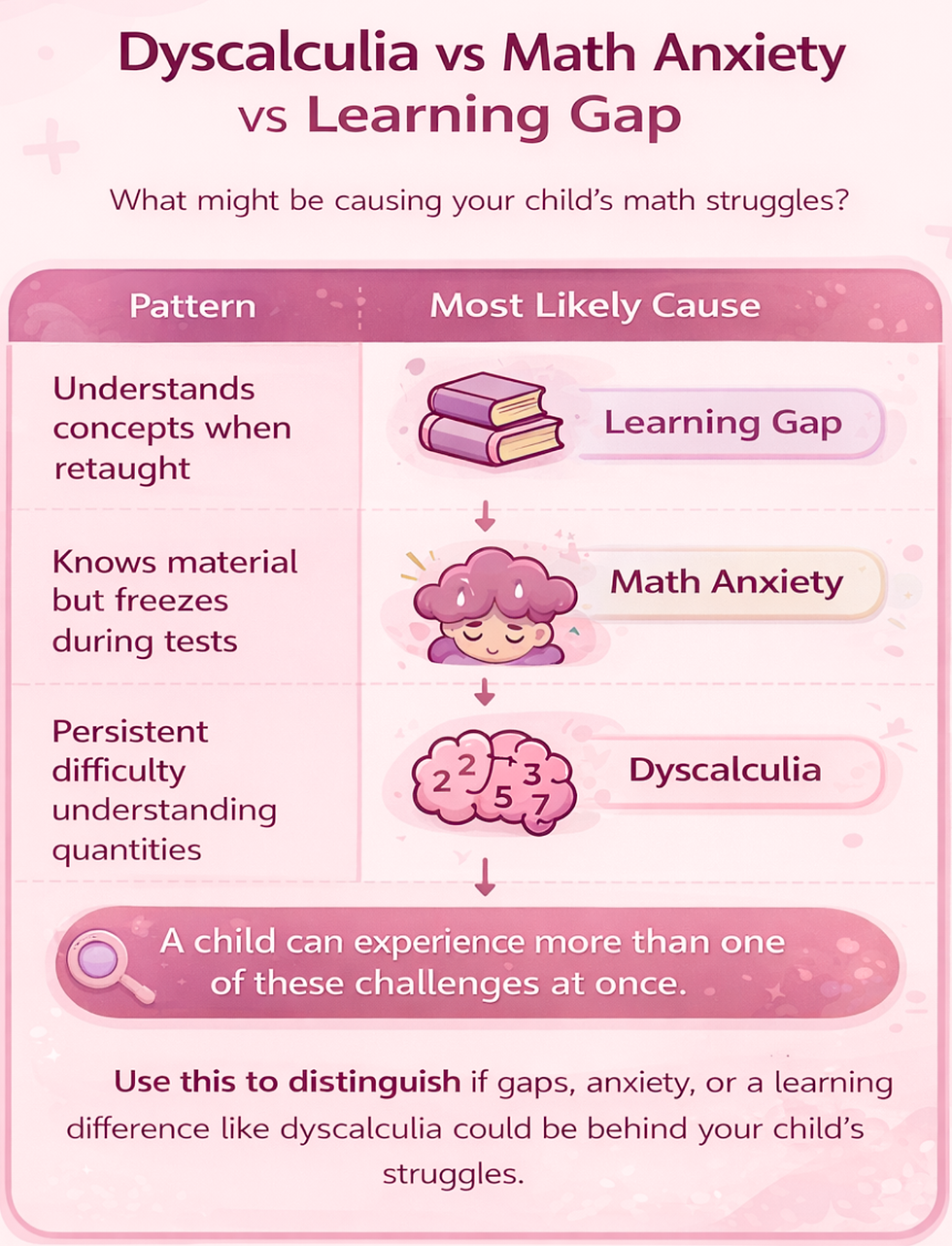
One of the most confusing parts of supporting a struggling math student is figuring out what is actually causing the difficulty.
The challenge is that these three situations can look similar on the surface, especially when a child is frustrated or avoiding math.
Understanding the differences can help parents begin to see what may really be happening.
When a Student Is Simply Behind
Some students struggle in math because they missed important foundational concepts earlier on.
This might happen if:
a student changed schools
a concept was rushed or poorly explained
the student was absent during an important unit
earlier math instruction did not fully stick
In these cases, the student may initially struggle with new material because the underlying foundation is incomplete.
Once those missing concepts are taught, these students usually make steady progress.
When Math Anxiety Is the Main Challenge
Research shows that math anxiety and dyscalculia frequently coexist, but they are separate conditions that require different forms of support (Geary, 2013).
Students with math anxiety often experience strong emotional reactions when faced with math tasks.
They may:
freeze during tests
panic when timed assignments are given
feel overwhelmed when looking at math problems
worry about making mistakes
Interestingly, many students with math anxiety do understand the material.
Many students with math anxiety understand the material but struggle to access what they know under pressure.
Math anxiety can significantly impact performance, even when the student is capable of understanding the material.
When Dyscalculia Is Part of the Picture
Dyscalculia, on the other hand, involves persistent difficulties with number sense and mathematical reasoning.
These challenges typically remain even when the student receives extra help or practice.
Students with dyscalculia often struggle with things like:
understanding numerical quantities
remembering math facts
comparing numbers
grasping place value
understanding fractions and ratios
keeping track of multi-step calculations
Even when concepts are retaught multiple times, the student may continue to feel confused because the underlying number relationships remain unclear.
A Quick Comparison
Pattern | What It Usually Means |
Child understands concepts when retaught | Learning gaps or being behind |
Child freezes during tests or timed assignments | Math anxiety |
Child consistently struggles with number sense and basic numerical concepts | Possible dyscalculia |
If you’d like a deeper breakdown of these differences, you can read more in Dyscalculia vs Math Anxiety vs Being Behind.
Many Students Experience More Than One of These
It is also important to remember that these categories are not always completely separate.
In fact, many students experience a combination of these factors.
Many students experience more than one of these challenges at the same time. For example, a child with dyscalculia may also have ADHD, dyslexia, or math anxiety, making math even more difficult.
Understanding the root causes of a child’s math struggles is the first step toward finding the type of support that will truly help them move forward.
When we identify what is actually happening, we can begin to provide instruction that addresses the real challenge rather than simply treating the symptoms.
Common Things Parents Often Hear
Parents of children with dyscalculia frequently hear comments like these from well meaning adults.
“Math takes practice for everyone.”
“They just need to try harder.”
“They’ll grow out of it.”
“They just need to slow down and be more careful.”
While these comments are usually well intentioned, they overlook an important reality: when a student has dyscalculia, more repetition alone is rarely enough. Students first need instruction that helps them develop meaningful number sense and conceptual understanding.
Why Traditional Math Instruction Often Fails Dyscalculia Students
Many parents begin to suspect something is wrong when their child receives extra help in math but still continues to struggle.
They practice math facts.
They review homework.
They repeat problems again and again.
Yet progress remains painfully slow.
When this happens, parents often assume the issue must be effort.
But in many cases, the real problem is that the instructional approach simply does not match how dyscalculic brains learn math.
Traditional math instruction works well for many students. However, it often relies on teaching methods that unintentionally create barriers for learners who struggle with number processing.
Let’s look at a few of the most common reasons.
Heavy Reliance on Memorization
Many math classrooms place a strong emphasis on memorizing facts and procedures.
Students are expected to quickly memorize things like:
• addition and subtraction facts
• multiplication tables
• formulas and algorithms
For students with strong number sense, memorization can be helpful.
But for students with dyscalculia, memorization without understanding can feel like trying to remember random information that never quite sticks.
Research consistently suggests that conceptual understanding should be developed before emphasizing memorization or procedural fluency (National Mathematics Advisory Panel, 2008). Without a clear understanding of how numbers relate to one another, memorized facts tend to disappear quickly.`
This is why many parents notice a frustrating pattern:
Their child studies math facts repeatedly, only to forget them again the next day.
The issue is not effort.
The issue is that the brain never developed the conceptual framework needed to anchor those facts.
Speed-Based Learning
Another common feature of traditional math instruction is speed.
Timed tests, rapid-fire drills, and fast-paced lessons are often used to encourage fluency.
However, for students with dyscalculia, speed can actually interfere with learning. Timed drills can place additional cognitive demands on students with mathematical learning disabilities and may increase anxiety rather than improve understanding (National Mathematics Advisory Panel, 2008).
When a child is rushing to complete math problems, their brain has less time to process numerical relationships.
Instead of thinking through the concept, they may feel pressure to guess or rely on memorized steps.
Over time, speed-based environments can lead to:
• increased anxiety• reduced confidence
• avoidance of math tasks
For many dyscalculic learners, slowing down the pace of instruction is essential for meaningful understanding.
Abstract Explanations Without Visual Support
Math is often taught using abstract symbols and verbal explanations.
Teachers may write equations on the board and explain the steps needed to solve them.
For many students, this approach works.
But for learners who struggle with number sense, abstract symbols can feel disconnected from meaning.
Without visual models or concrete representations, numbers may remain confusing symbols rather than meaningful quantities.
Visual supports such as number lines, diagrams, manipulatives, and models can help students see how numbers behave, making the concepts far easier to understand.
High Cognitive Load
Math problems often require students to manage several pieces of information at the same time.
A student might need to:
• remember multiple steps
• track numbers while calculating
• recall formulas
• interpret the problem itself
For students with dyscalculia, this can create a heavy cognitive load.
Their brain may become overwhelmed trying to keep track of all these elements at once.
When cognitive load becomes too high, students may lose their place in the problem, forget steps, or feel mentally exhausted.
Reducing cognitive load by breaking problems into manageable steps can make math far more accessible.
Emphasis on Procedures Rather Than Understanding
Traditional math instruction often focuses on teaching students how to perform procedures.
Students may learn steps such as:
“Carry the one.”
“Borrow from the next column.”
“Move the decimal.”
While these instructions can help students complete problems, they do not necessarily help them understand why those steps work.
Students with dyscalculia frequently struggle when they are asked to memorize procedures without understanding the underlying concepts.
When a problem changes slightly, the memorized steps may no longer apply, leaving the student confused.
Conceptual understanding — knowing why math works — is far more important for these learners than memorizing a sequence of steps.
When Instruction Matches the Brain, Math Begins to Make Sense
The good news is that students with dyscalculia can learn math successfully.
But they often need instruction that emphasizes:
• visual and concrete representations of numbers
• conceptual understanding before memorization
• slower pacing• reduced cognitive load
• explicit connections between mathematical ideas
When instruction is designed with these principles in mind, many students who once struggled deeply with math begin to experience something they have rarely felt before.
Clarity.
Concepts that once felt confusing begin to make sense.
Confidence slowly returns.
And math starts to feel less like an impossible puzzle and more like a system they can actually understand.

How Dyscalculia Is Diagnosed
Once parents begin to recognize the signs of dyscalculia, a common question naturally follows:
Should my child be evaluated?
For many families, a formal evaluation can provide clarity. It helps explain why a child is struggling with math and can guide decisions about the types of support that may be most helpful.
While the evaluation process can feel intimidating at first, understanding how it works often makes it much easier to navigate.
Neuropsychological Evaluations
One of the most comprehensive ways to evaluate for dyscalculia is through a neuropsychological evaluation.
These evaluations are typically conducted by a pediatric neuropsychologist or clinical psychologist who specializes in learning differences.
A neuropsychological evaluation examines how different areas of the brain are functioning, including skills that are directly related to learning and academic performance.
The evaluation may assess areas such as:
• number sense and numerical reasoning
• mathematical problem-solving
• working memory
• processing speed• visual-spatial reasoning
• attention and executive functioning• language processing
Because these evaluations examine multiple cognitive systems, they can help identify whether math difficulties are related specifically to dyscalculia or whether other learning differences may also be involved (DSM-5-TR; Mazzocco & Myers, 2003).
This is important because many students experience more than one learning difference, such as dyscalculia alongside ADHD or dyslexia.
A neuropsychological evaluation typically results in a detailed report that outlines the child’s strengths, areas of difficulty, and recommended supports.
Psychoeducational Testing
Another common type of evaluation is psychoeducational testing.
These assessments are usually conducted by a school psychologist or a private educational psychologist and focus more specifically on academic skills and learning abilities.
Psychoeducational evaluations often include standardized tests that measure:
• mathematical calculation skills
• applied problem solving
• reading ability
• written expression
• overall cognitive ability (IQ)
• academic achievement levels
By comparing a student’s academic performance to their cognitive abilities, evaluators can determine whether a learning disability such as dyscalculia may be present.
These evaluations are frequently used to determine eligibility for school-based services or accommodations.
School-Based Assessments
Public schools can also conduct evaluations to determine whether a student qualifies for support services.
Parents can request a school evaluation if they believe their child may have a learning disability.
School-based assessments may include:
• academic achievement testing
• classroom observations
• teacher input and progress data
• cognitive and processing assessments
If a learning disability is identified, the student may qualify for services under:
• an Individualized Education Program (IEP)
• a Section 504 Plan
While school evaluations can be very helpful, they are sometimes narrower in scope than private evaluations and may focus primarily on determining eligibility for services within the school system.
What Testing Typically Measures
When evaluating for dyscalculia, testing usually examines several areas related to how students process numerical information.
These may include:
Number Sense
Understanding quantities, numerical relationships, and how numbers compare to one another.
Mathematical Reasoning
The ability to solve problems and apply mathematical concepts.
Calculation Skills
Accuracy and fluency with basic arithmetic operations.
Working Memory
The ability to hold and manipulate information while solving a problem.
Processing Speed
How quickly a student can complete cognitive tasks.
Visual-Spatial Processing
Skills involved in interpreting spatial relationships and visual patterns.
Together, these measures help evaluators determine whether the student’s math difficulties are consistent with dyscalculia.
How a Diagnosis Can Help Families
A diagnosis can also help families access important forms of support.
These may include:
Academic Accommodations
Schools may provide accommodations such as:
• extended time on math tests
• reduced emphasis on timed math drills
• access to visual supports or manipulatives
• use of a calculator when appropriate
• modified assignments
These accommodations help level the playing field so students can demonstrate their understanding without being limited by processing challenges.
Specialized Instruction
A diagnosis can also guide families toward instructional approaches that are better suited to the way their child learns.
Students with dyscalculia often benefit from instruction that includes:
• explicit teaching of number sense
• multisensory learning strategies
• visual models and representations
• structured, step-by-step instruction
• repeated practice with conceptual understanding
When instruction is designed around these principles, students who once felt completely lost in math often begin to make meaningful progress.
A Clearer Understanding of the Child’s Learning Profile
Perhaps most importantly, an evaluation helps families see the whole picture of how their child learns.
Instead of focusing only on struggles, parents gain insight into their child’s strengths as well.
A thorough evaluation helps families understand both a child's strengths and challenges, allowing everyone involved to make more informed educational decisions.
School Accommodations for Students with Dyscalculia
For many families, receiving a diagnosis of dyscalculia raises an important question:
"What support can my child receive at school?"
The answer depends on your child's individual needs, but many students with dyscalculia benefit from classroom accommodations that reduce unnecessary barriers while allowing them to demonstrate what they truly know.
It's important to understand that accommodations do not make math easier or lower academic expectations. Instead, they provide students with equitable access to learning by reducing the impact of their disability.
The goal is not to give students an unfair advantage. The goal is to give them a fair opportunity to succeed.
Does Dyscalculia Qualify for an IEP or a 504 Plan?
Students with dyscalculia may qualify for either an Individualized Education Program (IEP) or a Section 504 Plan, depending on how significantly their learning differences affect their education.
An IEP is available to students who qualify for special education services under the Individuals with Disabilities Education Act (IDEA). In addition to accommodations, an IEP may include specialized instruction, measurable annual goals, and related services designed to address the student's unique learning needs.
A Section 504 Plan, on the other hand, is intended for students who do not require specialized instruction but still need accommodations to access the general education curriculum. These accommodations help reduce barriers caused by the disability while allowing students to participate in the same classroom instruction as their peers.
Eligibility is determined by the school through an evaluation process, and not every student with dyscalculia will qualify for the same type of support.
Common Classroom Accommodations for Dyscalculia
The most effective accommodations address the specific challenges associated with number processing rather than simply providing extra help.
Depending on the student's needs, schools may consider accommodations such as:
Extended Time
Many students with dyscalculia require additional time to process numerical information and complete calculations. Extended time on assignments, quizzes, and tests allows students to demonstrate their understanding without being penalized for slower processing speed.
Reduced or Eliminated Timed Math Drills
Timed math fact tests often measure processing speed more than mathematical understanding. Reducing or eliminating unnecessary timed activities can significantly decrease anxiety while allowing students to focus on developing conceptual understanding.
Calculator Access
For some students, calculators reduce the mental effort required for basic computation, allowing them to focus on higher-level mathematical reasoning and problem solving.
Calculator use should be considered thoughtfully and should support instruction rather than replace learning foundational concepts.
Graph Paper or Grid Paper
Graph paper helps students keep numbers properly aligned during calculations, reducing place value errors and improving organization during multi-step problems.
Visual Supports
Many students benefit from access to:
number lines
multiplication charts (when appropriate)
fraction models
place value charts
graphic organizers
step-by-step reference guides
These tools reduce working memory demands while reinforcing conceptual understanding.
Breaking Multi-Step Problems Into Smaller Parts
Long, complex problems can overwhelm working memory.
Teachers may provide assignments in smaller chunks or allow students to complete one section at a time before moving to the next step.
Alternative Ways to Demonstrate Understanding
Some students understand mathematical concepts but struggle to communicate that understanding through traditional written work.
Alternative assessments may include:
explaining reasoning verbally
using manipulatives
demonstrating concepts visually
completing fewer problems that measure the same skill
Copies of Notes and Worked Examples
Because many students are concentrating so hard on understanding the lesson, taking detailed notes at the same time can become overwhelming.
Providing teacher notes or completed examples allows students to focus on learning rather than copying information.
Accommodations Are Not the Same as Modifications
Parents often hear the terms accommodations and modifications used interchangeably, but they are very different.
Accommodations change how a student learns.
Examples include:
extended time
calculator access
graph paper
visual supports
reduced distractions
The learning expectations remain the same.
Modifications change what a student is expected to learn.
Examples might include:
simplified assignments
reduced curriculum expectations
alternate learning objectives
While modifications are appropriate for some students, many children with dyscalculia are fully capable of learning grade-level mathematics when provided with appropriate accommodations and effective instruction.
The Best Accommodation Is High-Quality Instruction
While accommodations can make school more accessible, they are not a substitute for specialized intervention.
A calculator cannot build number sense.
Extended time cannot teach conceptual understanding.
Graphic organizers cannot replace explicit instruction.
Accommodations help students access classroom learning, but lasting improvement comes from instruction that addresses the underlying difficulties with number processing.
The National Mathematics Advisory Panel (2008) concluded that students with mathematics difficulties benefit from instruction that emphasizes conceptual understanding alongside procedural fluency, while Gersten et al. (2009) identified explicit, systematic instruction as one of the most effective approaches for students struggling in mathematics. Together, these findings suggest that classroom accommodations are most effective when paired with high-quality, evidence-based intervention.
How Dyscalculia Affects Everyday Life`

When most people think about dyscalculia, they picture a child struggling with math homework.
But the truth is that math is woven into everyday life in ways many people do not realize.
Because dyscalculia affects how the brain processes numbers and quantities, its effects often extend far beyond the classroom.
Parents frequently notice challenges in everyday situations long before anyone identifies the underlying learning difference.
Once families understand dyscalculia, many of these patterns suddenly begin to make sense.
Telling Time
One of the earliest everyday challenges many children with dyscalculia experience involves telling time.
Learning to read an analog clock requires several number-processing skills at once.
A child must understand:
• number order
• counting by fives
• how the hour and minute hands interact
• how time progresses continuously
For students with dyscalculia, coordinating all of these concepts can be extremely difficult.
Parents may notice their child:
• confusing the hour and minute hands
• struggling to count by fives around the clock
• mixing up times like 3:20 and 3:40
• needing much longer than peers to learn how to read a clock
Even digital time can still be confusing if the child struggles to interpret what those numbers mean in real-world terms.
Managing Money
Handling money requires strong number sense and an understanding of value relationships.
Children with dyscalculia may struggle with:
• identifying coin values
• making change
• estimating total costs
• understanding how money accumulates
For example, a child might know that a quarter is worth more than a dime but still struggle to understand how much more.
Estimating Quantities
Estimation relies heavily on number sense — the ability to intuitively understand quantities and magnitude.
Students with dyscalculia often find estimation extremely difficult.
Parents might notice their child struggling with questions such as:
• “About how many people are in that room?”
• “How long will this take?”
• “How much do we need?”
Without strong number sense, it can be hard for a child to develop intuitive judgments about quantity or scale.
Following Directions
Many everyday instructions include hidden numerical concepts.
For example:
• “Turn left in about two blocks.”
• “Wait five minutes.”
• “Add two cups of flour.”
• “Take the second exit.”
Students with dyscalculia may struggle to interpret or remember these numerical components.
Even when they understand the directions verbally, the numbers embedded in them can create confusion.
`
Measuring Ingredients
Cooking and baking are full of mathematical concepts.
Recipes often require:
• fractions• measurement conversions
• proportional reasoning
Students with dyscalculia may struggle with tasks like:
• measuring ¾ cup of an ingredient
• doubling or halving a recipe
• understanding measurement relationships
These difficulties can make activities that involve measuring feel frustrating rather than enjoyable.
Understanding Distance and Spatial Relationships
Math skills also play a role in how we understand distance, scale, and spatial relationships.
Children with dyscalculia may struggle with concepts such as:
• estimating how far something is
• judging how long travel will take
• understanding maps or directions
• interpreting schedules
For example, a student might have difficulty understanding that a destination that is 20 miles away will take longer to reach than one that is 5 miles away.
These challenges can persist into adulthood if not supported.
Managing Time and Schedules
Many parents also notice that children with dyscalculia struggle with time management.
This is partly because time itself is a numerical concept.
Students may have difficulty:
• estimating how long tasks will take
• managing schedules
• keeping track of deadlines
• understanding time intervals
This can sometimes overlap with executive functioning challenges, which are common in students with learning differences.
Everyday Math Moments Add Up
While each of these situations may seem minor on its own, together they can significantly affect a child's confidence. Understanding that these struggles stem from differences in number processing rather than a lack of effort helps parents respond with greater empathy and more effective support.
And that understanding is the first step toward finding strategies and instruction that truly support how that child learns.
What Actually Helps Students With Dyscalculia

When a child struggles with math, the most common response is simple:
Give them more practice.
More worksheets.
More homework.
More repetition.
Unfortunately, for students with dyscalculia, more practice alone rarely solves the problem. In fact, repeatedly practicing procedures without first developing conceptual understanding can actually reinforce confusion because students are memorizing steps that have little meaning to them.
Over the past two decades, educational researchers have identified instructional approaches that consistently improve mathematical learning for students with mathematics difficulties. In its landmark report, the National Mathematics Advisory Panel (2008) concluded that effective mathematics instruction should develop conceptual understanding alongside procedural fluency rather than emphasizing memorization alone. Similarly, Gersten et al. (2009) found that explicit, systematic instruction significantly improves mathematical achievement for students who struggle with mathematics, while Butterworth, Varma, and Laurillard (2011) emphasized that students with dyscalculia benefit from instruction specifically designed to strengthen number sense and build meaningful numerical understanding.
Rather than simply asking students to practice more, these evidence-based approaches help them understand why mathematical procedures work, how numbers relate to one another, and how mathematical ideas connect across different concepts.
The instructional methods below represent some of the strongest evidence-based practices currently supported in the educational research literature. While no single intervention is appropriate for every learner, these approaches provide a strong foundation for helping students with dyscalculia develop deeper mathematical understanding, greater confidence, and lasting success.
Evidence-Based Teaching Methods That Help Students with Dyscalculia
By the time many families begin searching for answers about dyscalculia, they have often tried everything they know to help. They've purchased extra workbooks, hired tutors, practiced flashcards, and spent countless evenings working through homework together.
Yet despite everyone's best efforts, their child may still feel confused, frustrated, or convinced they're simply "bad at math."
This happens because effective dyscalculia intervention isn't about doing more math. It's about teaching math differently.
Over the past two decades, researchers have identified instructional approaches that consistently improve mathematical understanding for students with learning differences. While no single method works for every child, the strategies below have strong research support and share one important principle: they help students develop genuine understanding rather than relying solely on memorization.
When evaluating tutoring programs or interventions, parents should look for these evidence-based teaching practices.
Concrete-Representational-Abstract (CRA)
One of the most widely supported instructional methods for students with dyscalculia is the Concrete-Representational-Abstract (CRA) approach.
Rather than beginning with numbers written on a page, CRA teaches mathematical concepts through three carefully sequenced stages.
First, students manipulate concrete objects, such as counters, fraction tiles, base-ten blocks, or algebra tiles. These hands-on materials allow children to physically experience mathematical relationships before being asked to think about them abstractly.
Next, students move to representational learning, where they draw pictures, diagrams, number lines, or models to represent the same concepts they explored with manipulatives.
Only after demonstrating understanding with concrete materials and visual representations do students move to abstract symbols, such as numbers, equations, and formulas.
This progression helps students develop a deeper understanding of mathematical concepts because they are building meaning before memorization.
Research has consistently shown that CRA improves mathematical achievement for students with learning disabilities by strengthening conceptual understanding and long-term retention (National Mathematics Advisory Panel, 2008).
What parents should look for in a tutor:
Uses manipulatives regularly rather than occasionally.
Draws visual models instead of relying only on equations.
Doesn't rush students into abstract procedures before they understand the concepts.
Explicit Instruction
Many students with dyscalculia struggle to "figure out" mathematical relationships independently.
That's why research strongly supports explicit instruction, a teaching approach that leaves very little to chance.
Instead of expecting students to discover patterns on their own, the teacher clearly demonstrates each concept, models the thinking process aloud, provides guided practice, and gradually releases responsibility as the student gains confidence.
Lessons are carefully sequenced so that each new concept builds directly on previously mastered skills.
This structured approach reduces confusion and helps students develop accurate mathematical thinking from the very beginning.
Explicit instruction has repeatedly been identified as one of the most effective teaching methods for students with mathematical learning disabilities (Gersten et al., 2009; National Mathematics Advisory Panel, 2008).
What parents should look for in a tutor:
Explains the reasoning behind every step.
Models how to solve problems before expecting independent work.
Regularly checks for understanding instead of assuming mastery.
Multisensory Math Instruction
Students with dyscalculia often benefit from engaging multiple senses during learning.
Rather than simply listening to explanations or completing worksheets, multisensory instruction combines visual, auditory, verbal, and tactile experiences.
A child might:
build numbers with manipulatives,
say mathematical reasoning aloud,
draw visual models,
physically move objects,
trace number patterns,
explain concepts using their own words.
Engaging multiple sensory pathways helps strengthen neural connections and makes mathematical ideas more meaningful.
While multisensory instruction is widely recognized in reading intervention, growing evidence also supports its effectiveness in mathematics, particularly when combined with conceptual teaching (Butterworth et al., 2011).
What parents should look for in a tutor:
Uses hands-on materials frequently.
Encourages students to explain their thinking.
Incorporates visual models into nearly every lesson.
Number Sense Intervention
One of the defining characteristics of dyscalculia is difficulty developing number sense.
Number sense refers to an intuitive understanding of quantity, magnitude, numerical relationships, estimation, and flexibility with numbers.
Without strong number sense, students often rely on memorization because numbers never become meaningful.
Effective intervention spends significant time strengthening these foundational concepts rather than rushing into procedures.
Research suggests that strong early number sense is one of the best predictors of later mathematical success (Geary, 2013).
What parents should look for in a tutor:
Frequently uses number lines.
Encourages flexible thinking instead of one "correct" strategy.
Teaches why numbers behave the way they do.
Retrieval Practice
Many parents notice that their child seems to understand math during tutoring but forgets it a few days later.
This is where retrieval practice becomes important.
Rather than constantly reviewing notes, retrieval practice requires students to actively recall previously learned concepts from memory.
Each successful retrieval strengthens long-term retention and helps students develop more durable learning.
Instead of teaching a topic once and moving on forever, effective tutors regularly revisit earlier concepts.
Research in cognitive psychology consistently demonstrates that retrieval practice strengthens long-term learning more effectively than repeated rereading (Roediger & Karpicke, 2006).
What parents should look for in a tutor:
Reviews previously learned material every session.
Includes cumulative practice.
Doesn't assume mastered concepts stay mastered.
Spaced Practice
Closely related to retrieval practice is spaced practice.
Rather than practicing one concept intensively for a single day, learning is spread across weeks or months.
This spacing allows the brain to repeatedly strengthen mathematical concepts over time.
Although it may feel slower initially, spaced practice produces significantly better long-term retention than cramming (Cepeda et al., 2006).
What parents should look for in a tutor:
Revisits concepts regularly.
Spirals previously learned material into future lessons.
Doesn't abandon skills after one successful session.
Errorless Learning (When Appropriate)
Some students become so anxious about making mistakes that they stop taking risks altogether.
For these learners, tutors may occasionally use errorless learning, an instructional approach that provides enough support to prevent repeated failure while new concepts are being introduced.
This doesn't mean students never make mistakes.
Instead, it means the teacher carefully scaffolds instruction so students experience early success before gradually working more independently.
Reducing repeated failure can help rebuild confidence and decrease math anxiety, particularly for students who have experienced years of frustration.
What parents should look for in a tutor:
Provides appropriate scaffolding.
Builds confidence before increasing difficulty.
Corrects errors immediately and compassionately.
Schema-Based Instruction
Word problems require much more than computation.
Students must identify relevant information, recognize the problem structure, choose an appropriate strategy, and solve the mathematics.
Schema-based instruction teaches students to recognize common problem "types" instead of memorizing isolated procedures.
Once students recognize the underlying structure, solving becomes far more manageable.
Research has shown schema-based instruction significantly improves word-problem performance for students with mathematics difficulties (Jitendra et al., 2015).
What parents should look for in a tutor:
Teaches students to identify problem types.
Focuses on reasoning before computation.
Uses graphic organizers and visual models.
Executive Function Supports
Many students with dyscalculia also experience challenges with executive functioning, particularly when ADHD is present.
These skills include planning, working memory, organization, self-monitoring, and task initiation.
Effective tutors recognize that a child who loses their place during a long computation may not simply be "careless." They may be experiencing genuine working-memory overload.
Supports might include:
breaking complex problems into smaller steps,
visual checklists,
verbal self-talk,
organizational routines,
chunking information.
Supporting executive functioning reduces frustration and allows students to focus more mental energy on understanding mathematics.
What parents should look for in a tutor:
Breaks multi-step problems into manageable pieces.
Teaches organizational strategies.
Adjusts instruction for attention and working-memory needs.
Cognitive Load Theory
Every learner has a limited amount of information they can actively process at one time.
This concept, known as Cognitive Load Theory, is especially important for students with dyscalculia.
When lessons present too much new information at once, working memory becomes overloaded, making meaningful learning almost impossible.
Effective instruction minimizes unnecessary cognitive demands by presenting information in small, carefully organized steps while continuously connecting new learning to previously mastered concepts.
Reducing cognitive load allows students to devote more mental resources to understanding mathematics instead of simply trying to keep track of multiple pieces of information.
Research on cognitive load has significantly influenced modern mathematics instruction and instructional design (Sweller, 1988; Sweller, Ayres, & Kalyuga, 2011).
What parents should look for in a tutor:
Teaches one new concept at a time.
Avoids overwhelming students with multiple procedures simultaneously.
Carefully sequences instruction from simple to complex.
The Bottom Line
While there is no single "magic program" for dyscalculia, decades of educational research point in the same direction. Students make the greatest progress when instruction is explicit, conceptual, multisensory, carefully sequenced, and responsive to how their brains process numbers.
If you're looking for tutoring, don't be afraid to ask how math is taught. A tutor who can explain the instructional methods they use and why they use them is far more likely to provide meaningful, lasting progress than someone who simply promises more practice or better grades.
How Parents Can Support a Child With Dyscalculia
When parents first learn that their child may have dyscalculia, one of the first questions they ask is:
“What can I actually do to help?”
The good news is that there are many ways parents can support their child’s learning and confidence.
But one of the most important things to understand is this:
Helping a child with dyscalculia does not mean turning your home into a math classroom.
In fact, the goal is often the opposite.
Children with dyscalculia already spend a large part of their day feeling frustrated or overwhelmed by math. What they often need most at home is support, patience, and opportunities to experience math in ways that feel manageable and meaningful.
Shift the Focus From Speed to Understanding
Many children with dyscalculia feel constant pressure to work faster in math.
Timed tests, rapid-fire drills, and classroom pacing can make them feel like they are always falling behind.
At home, it can be incredibly helpful to remove that pressure.
Allow your child the time they need to think through problems.
Encourage them to explain their thinking.
Focus on understanding the concept rather than finishing quickly.
Educational research consistently shows that deep conceptual understanding produces stronger long-term retention than rote memorization alone (National Mathematics Advisory Panel, 2008).
When children are given space to think without feeling rushed, they are far more likely to develop real understanding.
Use Visual Supports Whenever Possible
For many dyscalculic learners, numbers alone can feel abstract and confusing.
Visual supports help turn those abstract symbols into something the brain can actually process.
Parents can help by using tools such as:
• number lines
• drawings and diagrams
• fraction models• counters or small objects
• visual grouping of quantities
For example, instead of simply saying that 3 × 4 = 12, you might draw four groups of three objects so your child can actually see how the quantities relate.
These visual connections help build the number sense that many dyscalculic learners struggle to develop.
Break Tasks Into Smaller Steps
Math problems often involve several steps at once.
For students with dyscalculia, keeping track of all those steps can quickly become overwhelming.
Breaking problems into smaller, manageable pieces can make a huge difference.
For example, instead of asking a child to solve a multi-step problem all at once, you might guide them through it step by step:
Understand the question.
Identify the numbers involved.
Decide which operation is needed.
Solve one step at a time.
Reducing the complexity of each moment helps lower the mental load on the child’s working memory.
Normalize Struggle and Protect Confidence
One of the most damaging things many dyscalculic learners experience is the belief that they are simply “bad at math.”
Over time, repeated struggles can affect a child’s confidence and willingness to try.
Parents can play an incredibly powerful role in protecting their child’s self-confidence.
It helps to remind children that:
• everyone’s brain learns differently
• struggling with math does not mean they are not intelligent
• many successful people have learning differences
When children feel emotionally safe while learning, they are far more willing to persist through difficult tasks.
Look for Math in Everyday Life
Math does not only exist in worksheets and textbooks.
In fact, some of the best opportunities to support mathematical thinking happen during everyday activities.
Parents might incorporate simple math conversations while:
• cooking or baking
• shopping at the grocery store
• planning travel time
• measuring ingredients
• comparing prices
These real-world experiences can help children see math as something practical and meaningful rather than something that only exists in school assignments.
Seek Instruction That Matches How Your Child Learns
Perhaps the most important support parents can provide is finding instruction that actually aligns with how their child learns.
Students with dyscalculia often benefit from teaching approaches that include:
• multisensory instruction
• strong visual models
• explicit number sense development
• slower pacing
• structured support for problem solving
When instruction matches the learner’s needs, math begins to feel far less confusing.
And for many students, that shift can change how they see themselves as learners.
Some parents also find it helpful to explore structured math activities and resources designed specifically for students who struggle with number sense.
You can find several of these in the MindBridge Math Resource Library.
What Progress Really Looks Like: A Realistic Timeline
One of the first questions parents ask after beginning dyscalculia intervention is:
"How long before we start seeing improvement?"
The honest answer is that every child is different.
Progress depends on many factors, including a student's age, the severity of their math difficulties, whether other learning differences such as ADHD or dyslexia are present, how often they receive instruction, and whether that instruction uses evidence-based teaching methods.
While no tutor or intervention can guarantee a specific timeline, many students follow a similar pattern of growth.
Perhaps the most important thing for parents to remember is this:
Confidence often improves before math skills do.
That may not sound like a major milestone, but it is frequently the first sign that meaningful learning is beginning.
Weeks 1-4: Building Confidence Before Building Skills
During the first few weeks, parents often hope to see dramatic academic improvement. In reality, the earliest changes are usually emotional rather than academic.
Many students begin to feel less anxious because they are finally being taught in a way that makes sense to them. They may become more willing to attempt challenging problems, ask questions, and persevere through mistakes instead of shutting down.
During this stage, parents often notice:
less resistance to math homework
reduced frustration and anxiety
increased willingness to try difficult problems
improved engagement during lessons
growing confidence
beginning to use visual models and strategies instead of guessing
Although academic progress may seem slow at first, this stage is incredibly important. Effective intervention often focuses on rebuilding foundational concepts before introducing more advanced skills, creating the strong mathematical foundation that later learning depends upon.
Months 2-3: Understanding Begins to Replace Memorization
As students continue receiving consistent instruction, many begin developing stronger number sense and a deeper understanding of mathematical relationships.
Instead of relying entirely on memorized procedures, they begin recognizing patterns, understanding why strategies work, and applying concepts more flexibly.
Parents commonly notice:
stronger number sense
improved understanding of place value and numerical relationships
fewer counting errors
increased accuracy with basic calculations
better retention between tutoring sessions
homework becoming less stressful and often completed more efficiently
This is also the stage where many children begin saying something parents have waited a long time to hear:
"I actually understand why that works."
For students with dyscalculia, that moment represents a significant milestone because conceptual understanding is beginning to replace memorization.
Four to Six Months: Greater Independence
As students build stronger mathematical foundations, they often become increasingly independent.
While challenging concepts may still require support, many students begin approaching new material with greater confidence because they now have strategies they can rely on.
Parents often notice:
improved long-term retention
increased confidence when approaching unfamiliar problems
greater willingness to explain their mathematical thinking
fewer emotional meltdowns during homework
improved organization during multi-step problems
less reliance on counting strategies for previously mastered skills
Many students also begin transferring strategies learned in tutoring to classroom assignments, demonstrating that they understand the concepts rather than simply memorizing procedures.
Six Months and Beyond: Lasting Mathematical Growth
Long-term progress with dyscalculia is rarely about becoming "good at math overnight."
Instead, it is about developing a strong mathematical foundation that supports future learning.
With consistent, evidence-based instruction, many students continue to develop:
stronger conceptual understanding
improved number sense
better long-term retention
increased flexibility when solving problems
greater independence during homework
reduced math anxiety
increased confidence both inside and outside the classroom
Perhaps the most meaningful change isn't found on a math worksheet.
It's hearing a child who once said,
"I'm just bad at math."
begin saying,
"This is hard, but I think I can figure it out."
That shift in confidence often becomes the foundation for continued academic growth.
Progress Is Rarely Linear
One final point is important for every parent to remember.
Progress with dyscalculia is rarely a straight line.
There will be weeks when everything seems to click, followed by weeks when previously learned concepts need additional review. That does not mean your child is moving backward. In fact, revisiting concepts is a normal part of building durable, long-term mathematical understanding.
The goal of intervention is not to move through the curriculum as quickly as possible. The goal is to help students develop mathematical understanding that lasts.
With patience, consistent instruction, and teaching methods that align with how their brain processes numbers, meaningful progress is absolutely possible.

When to Seek Extra Support
Many parents reach a point where they begin wondering:
“Is this something my child will grow out of, or do we need more support?”
Occasional struggles with math are completely normal. Every student finds certain concepts challenging from time to time.
However, when math difficulties persist for long periods of time—even with practice and classroom instruction—it may be a sign that a child needs more targeted support.
Seeking help does not mean something is “wrong” with your child. It simply means recognizing that they may benefit from instruction designed to match how their brain processes numbers.
Signs That Additional Support May Be Helpful
Parents may want to consider additional help if their child consistently experiences difficulties such as:
• struggling with basic number concepts long after peers have mastered them
• forgetting math facts or procedures soon after learning them
• relying heavily on counting strategies for simple calculations
• becoming overwhelmed or anxious when faced with math tasks
• avoiding math homework whenever possible• taking significantly longer than peers to complete math assignments
• continuing to struggle despite repeated practice or tutoring
When these patterns appear repeatedly, they often indicate that the child may need a different instructional approach rather than simply more practice.
When Classroom Support Is Not Enough
Teachers work hard to support students with many different learning needs, but classroom environments can present challenges for children with dyscalculia.
In most classrooms:
• lessons move quickly to keep pace with the curriculum
• instruction may rely heavily on verbal explanations or symbolic notation
• teachers must divide their attention among many students at once
Because of these realities, some students who need slower pacing, visual models, or highly structured instruction may continue to struggle even when their teacher is doing their best to help.
Additional support outside the classroom can provide the individualized attention and instructional strategies that some learners need in order to fully understand mathematical concepts.
The Role of Specialized Instruction
When students receive targeted support that matches how their brain processes numbers, learning can begin to look very different.
Effective support often focuses on:
• building strong number sense foundations
• strengthening conceptual understanding of mathematical ideas
• using visual and multisensory learning strategies
• breaking complex problems into manageable steps
• reducing cognitive overload during learning
Rather than focusing only on completing procedures, this type of instruction helps students understand how numbers behave and why mathematical relationships work the way they do.
For many students with dyscalculia, this deeper level of understanding is what finally allows math to start making sense.
Early Support Can Make a Significant Difference
The earlier a child receives appropriate support, the easier it is to strengthen foundational math skills.
When learning gaps are addressed early, students have more time to build the conceptual understanding needed for later topics such as:
• fractions
• ratios and proportions
• algebraic reasoning
• problem solving
However, it is important to remember that it is never too late to help a student develop stronger math skills.
Many older students and even adults are able to rebuild foundational understanding once instruction is presented in a way that aligns with how they learn.
Support Should Build Confidence, Not Just Skills
Academic support should not focus only on improving performance.
It should also help rebuild the confidence that many students lose after years of struggling with math.
Students who receive effective support often begin to experience:
• greater clarity when approaching math problems
• increased willingness to try challenging tasks
• reduced anxiety around math assignments
• a growing sense that they are capable learners
These changes can be just as important as the academic progress itself.
Every Child’s Learning Path Is Different
One of the most important things parents can remember is that there is no single path to learning math successfully.
Children with dyscalculia may require:
• more time• different instructional strategies
• targeted support for specific learning profiles
But with the right environment and guidance, many students are able to develop meaningful mathematical understanding and build the confidence they need to succeed.
Recognizing when extra support may help is not a sign of failure.
It is simply the first step toward giving a child the tools they need to move forward.
What the Future Can Look Like for Your Child

One of the quiet fears many parents carry is this:
“What will my child’s future look like?”
When math has been a daily struggle for years, it is completely natural to start wondering things like:
Will my child be able to go to college?
What kind of job could they have if math is always difficult?
Will this follow them forever?
These worries are incredibly common.
But here is something many parents are never told:
Dyscalculia does not determine a child’s potential.
It simply means that numbers do not process automatically in the brain the way they do for most people.
And while that can certainly make math classes harder, it does not prevent a person from building a successful, fulfilling life or career.
Many Successful Adults Have Dyscalculia
There are countless adults with dyscalculia who have built impressive and meaningful careers.
You will find people with dyscalculia working as:
• entrepreneurs and business owners
• executives and managers
• writers and journalists
• designers and artists
• scientists and engineers
• architects
• teachers
• therapists
• technology professionals
In many cases, the same brain differences that make math difficult also support strengths in other areas such as:
• creativity
• big-picture thinking
• problem solving
• storytelling and communication
• spatial reasoning
• innovation
Some students with dyscalculia even go on to work in fields that involve math — they simply rely on different tools, strategies, and ways of thinking.
College Is Absolutely Possible
Another common worry parents have is whether dyscalculia will prevent their child from attending college.
For many students, the answer is no.
With the right supports, many students with dyscalculia successfully attend college and graduate.
These supports may include:
• accommodations through disability services
• extra time on exams
• alternative ways of completing math requirements
• tutoring or academic coaching• assistive technology
Many universities today are far more aware of learning differences than they were in the past.
Students who understand how their brain works — and who have learned strategies that support their learning — can thrive in higher education.
The Real Goal Is Math Confidence, Not Math Perfection
One of the biggest misconceptions about dyscalculia is that the goal is to “fix” math ability entirely.
That is not actually the goal.
The goal is to help students:
• build functional number sense
• understand math concepts well enough to navigate daily life
• develop strategies that work for their brain
• rebuild confidence in their learning ability
When students feel capable again, something important happens.
They stop seeing themselves as “bad at school.”
And once that shift happens, their confidence often begins to grow in other areas of learning as well.
Your Child Is Far More Than Their Math Struggles
It is easy to forget this when homework turns into nightly battles.
But your child is not defined by their math difficulties.
They are defined by:
• their curiosity
• their creativity
• their sense of humor
• their kindness
• their unique way of thinking about the world
Many students who once struggled deeply with math grow into adults who build meaningful careers, strong relationships, and fulfilling lives.
Math may take them a little longer.
They may use different strategies.
But their future is still full of opportunity.
With the Right Support, Everything Can Change
The most important thing to understand is that dyscalculia does not mean a child is incapable of learning math.
It simply means they need to learn it in a different way.
When students finally receive instruction that makes sense to their brain, many things begin to shift:
• confusion turns into understanding
• frustration turns into curiosity
• avoidance turns into engagement
• “I’m just bad at math” turns into “I can actually do this.”
And that change can affect far more than just math class.
It can change how a child sees themselves as a learner.
Frequently Asked Questions About Dyscalculia
What is dyscalculia?
Dyscalculia is a neurodevelopmental learning disability that affects how the brain processes numbers and mathematical relationships. Officially recognized in the Diagnostic and Statistical Manual of Mental Disorders, Fifth Edition, Text Revision (DSM-5-TR) as Specific Learning Disorder with impairment in mathematics, dyscalculia can make it difficult to develop number sense, learn math facts, perform calculations, estimate quantities, understand mathematical concepts, and solve multi-step problems (American Psychiatric Association, 2022; Butterworth, Varma, & Laurillard, 2011).
Importantly, dyscalculia is not a reflection of intelligence or effort. Many students with dyscalculia are highly intelligent and excel in areas such as reading, science, creativity, or problem-solving. They simply process numerical information differently and benefit from specialized, evidence-based instruction that strengthens conceptual understanding rather than relying primarily on memorization.
How do I know if my child has dyscalculia or just needs more math practice?
Many children struggle with math at some point, especially if they have missed foundational skills. However, dyscalculia tends to look different from simple learning gaps. Children with dyscalculia often struggle with basic number sense, such as understanding quantities, estimating amounts, remembering math facts, or recognizing number relationships—even after repeated instruction and practice (Butterworth, Varma, & Laurillard, 2011; Geary, 2013).
If math difficulties are persistent, severe, and appear across many different types of math tasks, it may be worth exploring whether a learning difference such as dyscalculia is involved.
Is dyscalculia considered a disability?
Yes. Dyscalculia is recognized in the Diagnostic and Statistical Manual of Mental Disorders as Specific Learning Disorder with impairment in mathematics. Depending on how significantly it affects a child’s education, a student may qualify for accommodations, specialized instruction, or support through an IEP or Section 504 Plan (American Psychiatric Association, 2022).
Can a gifted child have dyscalculia?
Yes. Dyscalculia is not related to intelligence. A child may be gifted in reading, science, writing, creativity, verbal reasoning, or other areas while still experiencing significant difficulty with numbers and mathematical relationships. These students are sometimes described as twice-exceptional, or 2e, because they have both advanced abilities and a learning disability. Because their strengths often compensate for their weaknesses, gifted students with dyscalculia may go undiagnosed until higher-level mathematics places greater demands on conceptual understanding.
Can children with dyscalculia succeed in school?
Yes. Many students with dyscalculia succeed academically when they receive the right kind of support. Success is most likely when students receive evidence-based instruction that develops number sense, conceptual understanding, and mathematical reasoning while also providing appropriate accommodations and emotional support.
When instruction matches how the student’s brain processes numbers, many children begin to build confidence and make meaningful progress in math.
Is dyscalculia hereditary?
Several studies have found that dyscalculia tends to run in families, suggesting that genetics may contribute to its development (Shalev & Gross-Tsur, 2001). A family history does not guarantee that a child will have dyscalculia, but parents frequently recognize similar math difficulties in themselves or other relatives after their child is evaluated (Shalev & Gross-Tsur, 2001).
Should my child be tested for dyscalculia?
If math struggles are persistent, severe, and affecting academic confidence, a formal evaluation may be helpful. Psychoeducational or neuropsychological assessments can examine skills such as number sense, working memory, processing speed, and mathematical reasoning.
A clear diagnosis can help families better understand their child’s learning profile and may also help students access appropriate accommodations and specialized support.
At what age can dyscalculia be diagnosed?
Some warning signs appear during preschool, particularly difficulties developing number sense and understanding quantities. However, a formal diagnosis is typically made once children have received enough math instruction for persistent patterns of difficulty to become evident. Early identification allows intervention to begin sooner (American Psychiatric Association, 2022).
Does dyscalculia qualify a child for an IEP or 504 Plan?
It may. A student with dyscalculia may qualify for an IEP when the condition significantly affects educational performance and the student requires specialized instruction. A Section 504 Plan may be appropriate when the student does not require special education but still needs accommodations to access the general curriculum. Eligibility is determined through an evaluation process and depends on the child’s individual needs.
Learn more in the School Accommodations for Students with Dyscalculia section above.
What school accommodations help students with dyscalculia?
Helpful accommodations may include extended time, reduced or eliminated timed math drills, calculator access when appropriate, graph paper, visual supports, teacher-provided notes, chunked assignments, and alternative ways to demonstrate understanding. Accommodations should be individualized rather than applied as a one-size-fits-all checklist.
For a more detailed explanation of each accommodation and when it may be appropriate, see the School Accommodations for Students with Dyscalculia section above.
Can dyscalculia be cured?
There is currently no cure for dyscalculia. However, studies by Butterworth, Varma, and Laurillard (2011) and Gersten et al. (2009) demonstrate that students with dyscalculia can make significant progress through evidence-based intervention that strengthens number sense, conceptual understanding, and mathematical reasoning.Many students become successful, confident mathematicians when taught using methods that match how they learn.
Can dyscalculia improve?
Yes. Dyscalculia does not simply disappear, but students can build stronger number sense, improve mathematical reasoning, develop effective strategies, and become more confident with appropriate intervention. Progress is usually gradual and depends on consistent instruction that emphasizes conceptual understanding rather than memorization alone.
How long does dyscalculia intervention take?
There is no single timeline that applies to every student. Progress depends on factors such as age, the severity of the learning difficulty, co-occurring conditions, instructional frequency, and the methods being used. Many families notice reduced anxiety and increased willingness to try before they see major academic changes. More substantial growth in number sense, retention, and independence generally develops over months rather than weeks.
See the What Progress Really Looks Like: A Realistic Timeline section above for a more detailed overview of what families commonly experience during intervention.
Is dyscalculia related to ADHD?
Dyscalculia and ADHD are separate conditions, but they frequently occur together. Dyscalculia affects number processing and mathematical reasoning, while ADHD primarily affects attention, working memory, organization, and self-regulation. When both are present, students may need support for both mathematical understanding and executive functioning (American Psychiatric Association, 2022).
Is dyscalculia the same as math anxiety?
No. While the two can look similar, they are not the same.
Math anxiety is an emotional response to math, often caused by repeated frustration or negative experiences. Dyscalculia, on the other hand, is a neurological learning difference that affects how the brain processes numbers and quantities.
That said, many students with dyscalculia eventually develop math anxiety because math has been so difficult for them (Ashcraft & Krause, 2007).
Can adults have dyscalculia?
Yes. Dyscalculia continues into adulthood, although many adults develop coping strategies that help them manage daily tasks. Adults may still struggle with mental math, budgeting, estimating time, measuring, calculating tips, reading schedules, or understanding financial information. Specialized instruction and practical strategies can still be helpful at any age.
What should parents look for in a dyscalculia tutor?
Parents should look for a tutor who understands dyscalculia as more than a problem with math facts or homework completion. Effective instruction should include explicit teaching, visual models, multisensory learning, number-sense development, structured progression, and support for working memory and executive functioning. A qualified tutor should also be able to explain why a particular strategy is being used and how it addresses the student’s learning needs.
Parents should also look for someone who can explain the research behind their instructional methods rather than relying solely on experience or intuition. Effective intervention should be grounded in evidence-based practices that have been shown to improve mathematical learning.
Does online tutoring work for dyscalculia?
Yes. Online tutoring can be effective when it is individualized, interactive, and designed around evidence-based teaching methods. Digital manipulatives, visual models, screen annotation, interactive number lines, and one-to-one instruction can make abstract mathematical ideas more concrete while allowing lessons to be tailored to the student’s pace and learning profile.
The quality of the instruction is far more important than whether it occurs online or in person.
What kind of help actually works for dyscalculia?
Students with dyscalculia typically benefit from evidence-based instructional approaches such as Concrete-Representational-Abstract (CRA) instruction, explicit instruction, multisensory learning, schema-based instruction, retrieval practice, and carefully scaffolded lessons that build number sense and conceptual understanding.
Simply assigning more worksheets or asking students to memorize math facts rarely solves the underlying difficulty.
With the right instruction, many students who once believed they were “bad at math” begin to see that they are capable learners after all.
My child hates math. Is there still hope?
Absolutely.
Many students with dyscalculia have spent years believing they simply "aren't math people." In reality, they often haven't been taught in a way that matches how their brains process numbers. With patience, appropriate accommodations, and evidence-based instruction, students can build confidence, develop genuine mathematical understanding, and discover that success in math is possible. In many cases, the greatest transformation isn't simply improved math performance. It's watching a child who once believed they were "bad at math" begin to see themselves as capable, confident learners..
Final Thoughts and Next Steps
If you suspect your child may have dyscalculia, you are not alone.
Many parents spend years wondering why math seems so much harder for their child than it does for other students. They watch their child try, study, and practice—yet the same struggles keep appearing.
Over time, those struggles can start to affect more than just math grades.
Children may begin to believe things like:
“I’m just bad at math.”“
I’ll never understand numbers.”
“I’m not smart.”
As a parent, those moments can be incredibly difficult to watch.
But it’s important to understand that difficulty with math does not mean a child lacks intelligence or potential.
Dyscalculia simply means that the brain processes numbers differently (Butterworth et al., 2011).
And when instruction is designed with that difference in mind, many students begin to experience something they may not have felt before in math:
Clarity.
Concepts that once felt confusing start to make sense. Confidence slowly begins to grow. And students start to realize that they are far more capable than they once believed.
Considering Next Steps
If you suspect your child may be struggling with dyscalculia or persistent math difficulties, it can be incredibly helpful to talk through what you’re seeing with someone who understands how these learning differences affect math learning.
During a consultation, we can discuss:
• the specific math challenges your child is experiencing
• whether those patterns may be consistent with dyscalculia or another learning difference
• what types of instruction or support may be most helpful
• possible next steps for evaluation, accommodations, or targeted intervention
Sometimes even a short conversation can provide a great deal of clarity and direction for families.
If you would like to better understand your child’s learning profile and explore possible supports, you can schedule a consultation here:
What Parents Can Do Next
If you recognize many of the signs discussed in this guide, there are several steps you can take to better understand and support your child’s learning.
You may want to consider:
• learning more about how dyscalculia affects number processing
• observing the types of math tasks that are most difficult for your child
• speaking with your child’s teacher about the challenges you are seeing
• exploring whether a formal evaluation might be helpful
• seeking instructional support that focuses on conceptual understanding
Each child’s learning path is different, but gaining clarity about the underlying challenges is often the first step toward meaningful progress.
A Final Word of Encouragement
If you’ve taken the time to read through this guide, it likely means you are deeply committed to helping your child succeed.
That dedication matters more than you may realize.
Children benefit enormously from having adults in their lives who are willing to ask questions, seek answers, and advocate for the support they need.
Math may feel overwhelming right now.
But with patience, the right strategies, and instruction that aligns with how your child learns, meaningful progress is absolutely possible.
And sometimes the first step toward that progress is simply understanding that your child’s struggle has a name—and that solutions do exist.

Founder & Educational Clinician, MindBridge Math Mastery
Susan Christine Ardila, M.Ed. is the founder of MindBridge Math Mastery, a virtual practice specializing in dyscalculia, math intervention, executive functioning, and learning differences. She has over 12 years of experience helping students with dyscalculia, ADHD, autism, and other learning differences using evidence-based, multisensory instruction.
Master of Education (M.Ed.) in Curriculum & Instruction, Mathematics Education (K-12), University of Texas at Arlington
Bachelor of Science (B.S.)in Interdisciplinary Studies, Texas A&M University (Summa Cum Laude)
Texas Certified Teacher (EC-6 Generalist and Mathematics 4-8)
Completed Dyscalculia Tutor Training (Dr. Schrueder)
NILD Educational Therapy® Level I
Marilyn Zecher Multisensory Math (Levels 1 & 2)
SMARTS Executive Function Fundamentals/MS & HS
Trained Educational Clinician
Additional Executive Function Training (including current coursework with Peg Dawson)
Study Skills Coach (Anti-boring Learning Lab)
Over 12 years of experience, including classroom teaching, curriculum development, and specialized math intervention for students with dyscalculia and other learning differences.
References
Dyscalculia research and educational psychology literature commonly referenced in this article includes:`
Butterworth, B., Varma, S., & Laurillard, D. (2011). Dyscalculia: From Brain to Education. Science, 332(6033), 1049–1053.
Geary, D. C. (2013). Early Foundations for Mathematics Learning and Their Relations to Learning Disabilities. Current Directions in Psychological Science, 22(1), 23–27.
Mazzocco, M. M. M., & Myers, G. F. (2003). Complexities in Identifying and Defining Mathematics Learning Disability. Learning Disability Quarterly, 26(3), 218–223.
National Mathematics Advisory Panel. (2008). Foundations for Success: The Final Report of the National Mathematics Advisory Panel. U.S. Department of Education.
Shalev, R. S., & Gross-Tsur, V. (2001). Developmental Dyscalculia. Pediatric Neurology, 24(5), 337–342.
Understood.org. (n.d.). Dyscalculia: What It Is and What It Isn’t.
International Dyslexia Association. (n.d.). Understanding Math Learning Disabilities.
American Psychiatric Association. (2022). Diagnostic and Statistical Manual of Mental Disorders (5th ed., text rev.; DSM-5-TR). American Psychiatric Publishing.
National Center for Learning Disabilities. (n.d.). Understanding Dyscalculia.
Cepeda, N. J., Pashler, H., Vul, E., Wixted, J. T., & Rohrer, D. (2006). Distributed practice in verbal recall tasks: A review and quantitative synthesis. Psychological Bulletin, 132(3), 354-380.
Gersten, R., Beckmann, S., Clarke, B., Foegen, A., Marsh, L., Star, J. R., & Witzel, B. (2009). Assisting Students Struggling with Mathematics: Response to Intervention (RtI) for Elementary and Middle Schools. Institute of Education Sciences.
Jitendra, A. K., Star, J. R., Rodriguez, M., Lindell, M., & Someki, F. (2015). Improving students' proportional thinking using schema-based instruction. (Or another Jitendra schema-based instruction paper if you prefer.)
Roediger, H. L., & Karpicke, J. D. (2006). Test-enhanced learning: Taking memory tests improves long-term retention. Psychological Science, 17(3), 249-255.
Sweller, J. (1988). Cognitive Load During Problem Solving: Effects on Learning. Cognitive Science, 12(2), 257-285.
Sweller, J., Ayres, P., & Kalyuga, S. (2011). Cognitive Load Theory.


Comments